
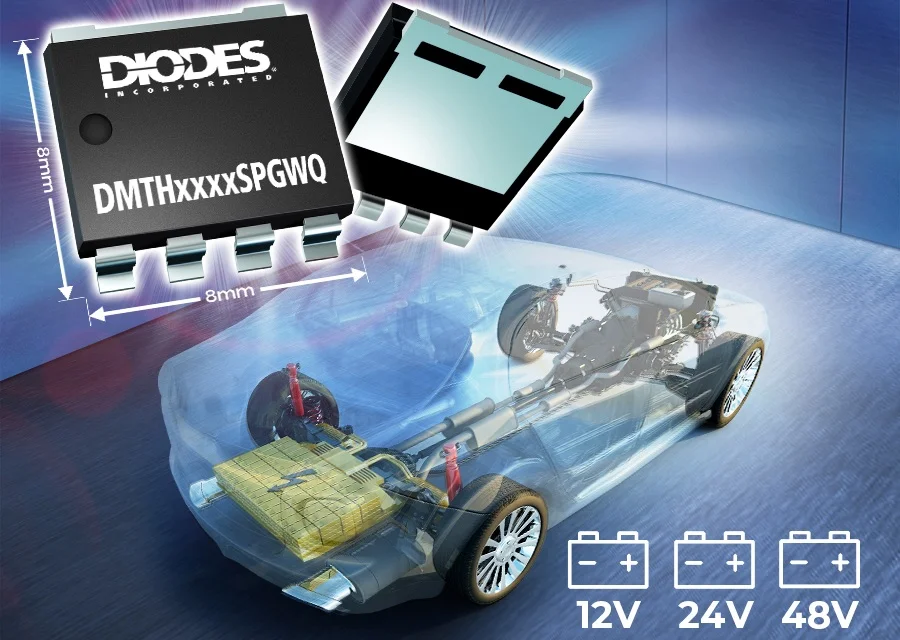
 Automotive power stages are being asked to carry more current without getting any more room on the board. That pressure shows up quickly in 48 V subsystems, where conduction loss, heat, and package size all start arguing with each other at the same time. A low RDS(ON) number matters, but only if the device can still fit into a compact layout and survive the thermal load that comes with it.
Diodes has introduced a new set of automotive-compliant PowerDI8080-5 MOSFETs for exactly that sort of design space. The DMTH10H1M7SPGWQ is a 100 V N-channel MOSFET used in 48 V automotive systems such as BLDC motor drives, battery disconnect switches, and onboard chargers. It arrives alongside new 40 V to 80 V devices in the same 8 mm x 8 mm gullwing package, which makes this launch about more than a single flagship part. In electric power steering or braking systems, for example, the MOSFET is sitting in a part of the design where current handling, thermal behavior, and footprint all have to hold together at once.
Why 48 V Makes RDS(ON) Matter Faster
Once vehicle subsystems move into 48 V territory, the MOSFET decision stops being a routine voltage-rating exercise. Higher current loads in BLDC drives and conversion stages mean on-state losses start becoming expensive very quickly, and that changes what counts as useful headroom. That is where the DMTH10H1M7SPGWQ starts to matter. Diodes rates the device at a maximum RDS(ON) of 1.5 mΩ and positions it for 48 V BLDC motor drives in steering and braking systems, with other high-power roles including battery disconnect switches and onboard chargers. There is also the 80 V DMTH81M2SPGWQ for designs that do not need the full 100 V rating but still want the same package style and general thermal approach.
The Package Is Carrying Part Of The Story
A smaller MOSFET package only helps if it stays thermally credible. Diodes says the PowerDI8080-5 package uses just 64 mm² of PCB area, around 40 percent of the area occupied by a legacy TO-263 package, while keeping the off-board profile down to 1.7 mm. That is the sort of reduction that matters in compact automotive power stages, where mechanical packaging rarely gets easier as electrical demands rise. The thermal path is just as important. According to Diodes, copper clip die bonding reduces junction-to-case thermal resistance to as low as 0.3°C/W and enables drain currents as high as 847 A without risk of damage. That number will always depend on how the surrounding system is built, but the intent is clear enough. This package is meant to carry serious current without forcing the board to grow around it.
One Package Family Across Several Vehicle Rails
The wider family is probably just as relevant as the 100 V headline device. The 40 V DMTH4M40SPGWQ comes in at a maximum RDS(ON) of 0.4 mΩ, which Diodes positions for 12 V BLDC motors and DC-DC applications. The logic-level 40 V DMTH4M40LPGWQ offers 0.64 mΩ at a gate-source voltage of 4.5 V, which makes it more suitable for microcontroller-driven automotive nodes such as actuators, fan controls, and load switches. For 24 V designs, the 60 V DMTH6M70SPGWQ fills the gap. That spread gives automotive designers a more consistent packaging and thermal approach across different voltage domains inside the same vehicle. It also makes the launch feel more useful than a single standout MOSFET announcement. The family is clearly being shaped around real power-stage variation rather than one isolated benchmark part.
Manufacturing Details Still Matter In Automotive
The gullwing lead structure is another part of the story. Diodes says it supports automated optical inspection and improves temperature cycling reliability, both of which matter in automotive manufacturing where package choice is tied closely to assembly visibility and long-term robustness.
That is what gives this launch some weight. The low RDS(ON) figures are important, but the more useful point is that Diodes is trying to bring high-current automotive MOSFET performance into a smaller, lower-profile, inspection-friendly package without letting thermal performance fall apart in the process.
Learn more and read the original announcement at www.diodes.com
Technology Overview
The Diodes DMTH10H1M7SPGWQ is an automotive-compliant 100 V N-channel MOSFET in the PowerDI8080-5 package for 48 V automotive power systems. It offers a maximum RDS(ON) of 1.5 mΩ and is intended for applications such as BLDC motor drives, battery disconnect switches, and onboard chargers.
Frequently Asked Questions
What is the DMTH10H1M7SPGWQ used for?
It is used in 48 V automotive systems including BLDC motor drives for steering and braking, battery disconnect switches, and onboard chargers.
What package does the DMTH10H1M7SPGWQ use?
It uses the PowerDI8080-5 package, an 8 mm x 8 mm gullwing-leaded package with a 64 mm² PCB footprint.
You may also like