
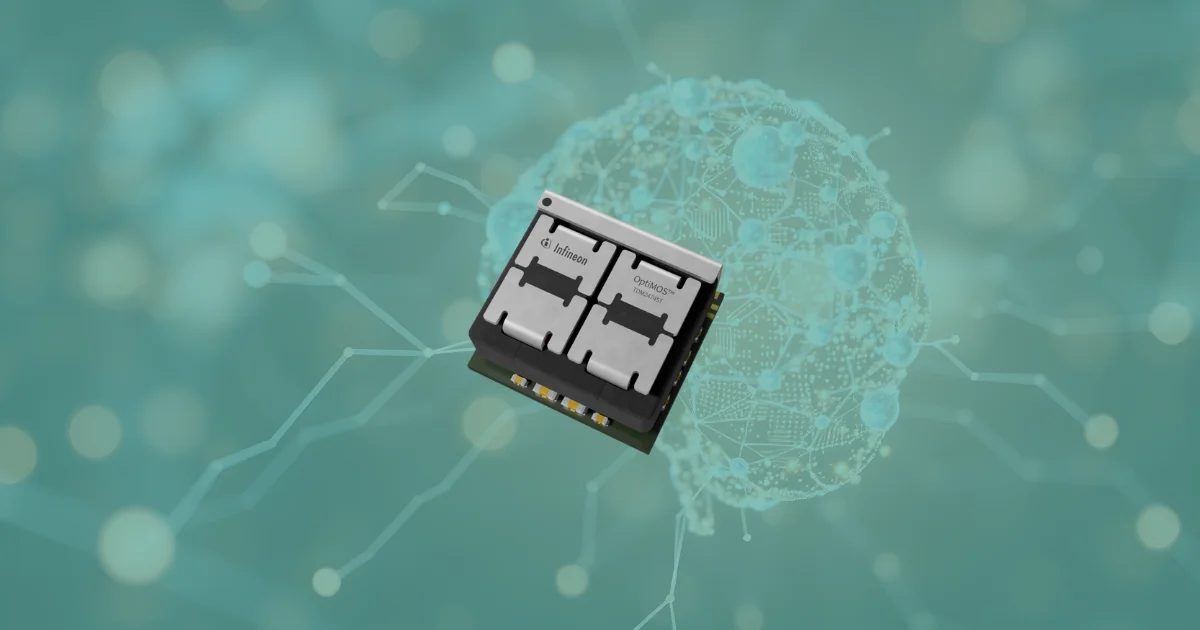
 Power delivery around AI processors is starting to look less like a supporting circuit and more like a packaging problem. The current is enormous, the transient behavior is less forgiving, and the board space around modern accelerators is getting squeezed from every direction. That is the context for Infineon’s new TDM24745T, a quad-phase power module built around TLVR architecture and aimed directly at the core rail problem inside next-generation AI servers.
The TDM24745T is a quad-phase power module used to supply high-current core rails for AI accelerators, GPUs, and other multiprocessor compute platforms. Infineon has packed four power stages, a TLVR inductor, and decoupling capacitors into a 9 x 10 x 5 mm package, with current density exceeding 2 A/mm² and peak current capability up to 320 A. In an AI server board, that matters less as a headline number and more because the voltage regulator is no longer sitting in a comfortable corner of the system. It is being pulled physically closer to the processor while being asked to react faster and fit into a much tighter power-delivery envelope.
AI Core Rails Are Forcing Power Closer To The Load
That shift is really what this launch is about. AI processors are pulling so much current, and doing it with such aggressive load steps, that traditional multiphase conversion approaches are starting to run into physical limits. The regulator has to stay compact, but it also has to be electrically fast enough to stop the core rail from dipping or overshooting every time the compute engine changes state.
Infineon is using TLVR, or trans-inductor voltage regulator architecture, to deal with that pressure. The benefit is not just better transient response in the abstract. It is that the power stage can react harder without relying on the same amount of output capacitance to hold the rail together. That becomes a very practical board-level advantage once the rail current is high enough that capacitor count, placement, and loop behavior start dominating the layout.
Cutting Capacitance Changes More Than The BOM
Infineon says the TLVR approach can reduce required output capacitance by up to 50%. That is one of the more important details in the release because output capacitors are not just a line item. Around high-current processor rails, they consume area, affect placement freedom, and shape how aggressively the whole power stage can be packed around the load.
Once some of that capacitance burden eases, the regulator footprint starts changing in a useful way. The TDM24745T is still a dense part, but reducing the external support requirement gives system designers more room to work with around the processor. In vertical and lateral power delivery layouts alike, that matters because every millimeter near the load is already under pressure from routing, cooling, and mechanical constraints.
The Package Is Small Because The Problem Is Not
Infineon has gone after integration hard here. Four power stages, embedded components, decoupling, proprietary magnetics, and OptiMOS 6 MOSFET technology all end up inside a 9 x 10 x 5 mm package. That sounds impressive, but the real point is that the module is trying to compress what would otherwise spill across the board into something far more contained.
That kind of integration helps for reasons beyond neatness. High-current rails are messy once parasitics start showing up where the simulation looked clean. Bringing the critical pieces together can improve electrical control and thermal behavior at the same time, which is exactly what dense AI server boards need. It also helps explain why Infineon is positioning this as suitable for both lateral and vertical power delivery schemes. The package has to be compact enough to stay relevant whichever way server designers choose to move the regulator toward the processor.
This Is Where AI Power Design Is Heading
Infineon is calling the TDM24745T the industry’s first TLVR quad-phase module in this compact form factor, and whether competitors move quickly or not, the direction is obvious enough. AI compute is forcing power designers to think less about individual conversion stages and more about how the entire delivery path behaves under extreme current density, limited board area, and punishing transient demands.
The interesting part is not simply that this module exceeds 2 A/mm². It is that power delivery around AI processors is no longer scaling through bigger support networks and more forgiving placement. It is being pushed into tighter, more integrated structures where electrical performance, thermal behavior, and physical proximity all start collapsing into the same design problem.
Learn more and read the original announcement at www.infineon.com
Technology Overview
The Infineon TDM24745T is a quad-phase TLVR power module designed to supply high-current core rails for AI accelerators, GPUs, and multiprocessor compute platforms. It integrates four power stages, a TLVR inductor, and decoupling capacitors into a 9 x 10 x 5 mm package, delivering current density above 2 A/mm² and peak current capability up to 320 A.
Frequently Asked Questions
What is the Infineon TDM24745T used for?
The TDM24745T is used to power high-current core rails in next-generation AI processors, GPUs, and high-current multiprocessor platforms.
What current capability does the Infineon TDM24745T support?
Infineon states that the TDM24745T supports peak current capability up to 320 A and current density exceeding 2 A/mm².
You may also like