
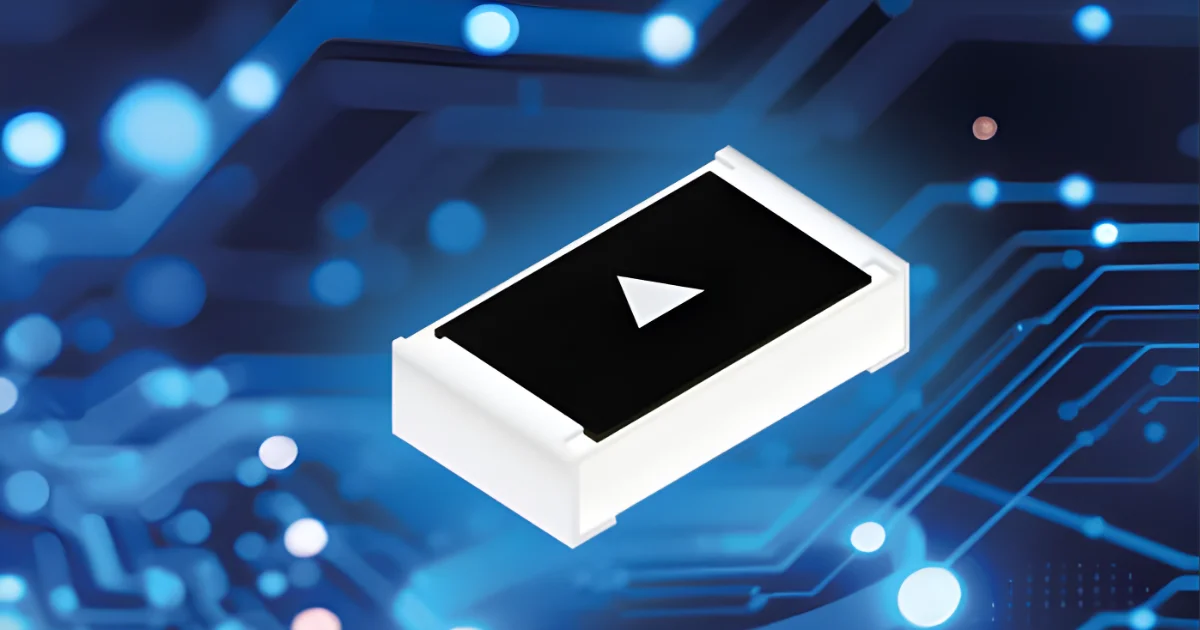
 Resistor selection gets awkward once accuracy starts climbing. Thick film is usually the cheaper and more forgiving option, but as soon as tolerance tightens and temperature drift starts affecting the rest of the circuit, thin film tends to take over. Panasonic Industry is pushing back on that divide with its ERJPC series, a set of high-precision thick-film resistors that are clearly aimed at designs where engineers want tighter electrical behavior without paying the usual penalty in size or cost.
The ERJPC series is a family of high-precision thick-film resistors used in sensing, feedback, and measurement circuits that need low drift, tight tolerance, and compact board footprints. Panasonic is quoting tolerance options down to ±0.1% and ±0.5%, with TCR figures as low as 25 ppm/K. In a battery management system or industrial control board, that kind of resistor usually ends up doing the quiet work around voltage sensing, current measurement, and reference scaling, which is exactly why poor stability tends to show up later as a much bigger problem than expected.
Thick Film Usually Gives Something Up
The reason this release is worth looking at is simple enough. Thick film parts are not normally where engineers go when they want something approaching thin-film precision. They get used because they are practical, cost-effective, and generally easier to justify in high-volume hardware. The problem is that once the error budget gets tighter, that practical choice can start creating work elsewhere in the design.
Panasonic is clearly trying to make that tradeoff less annoying. By claiming thin-film-level accuracy from a thick-film platform, the ERJPC series moves into a space that thick film does not usually own. That does not suddenly make thin film irrelevant, but it does give designers another option when they are trying to balance precision against board density and cost instead of treating those as separate decisions.
Power Density Changes The Decision Fast
The more interesting part of the release is probably not the tolerance headline on its own. It is the power density. Panasonic says the ERJPC series delivers up to twice the power density of thin-film solutions, with 0.2 W available in a 0603 package and 0.25 W in 0805. That is the kind of detail that can change a layout faster than a small improvement in resistance tolerance ever will.
If a resistor can carry more power in a smaller footprint while still staying inside a tighter accuracy window, then the packaging decision starts shifting with it. Panasonic says designers may be able to save up to 50% of the footprint by replacing thin-film components with smaller-case ERJPC parts. On a dense board, that is rarely just a resistor story. It changes routing room, spacing pressure, and sometimes whether a section of the board feels constrained or manageable.
Stability Is Where Precision Parts Get Judged
This is also where resistor launches tend to get oversimplified. Initial tolerance numbers look tidy in a table, but real circuits do not stay at room temperature in ideal conditions for very long. TCR, long-term drift, and environmental stability are usually what decide whether a precision resistor is genuinely useful or just well behaved on paper.
Panasonic is leaning into that broader point. The company says the ERJPC series combines low TCR and tight accuracy with stronger environmental stability, bringing total tolerance much closer to thin-film-level performance than conventional thick-film resistors. That is a more credible engineering argument than simply saying the parts are precise, because it shifts the discussion from nominal value to how the resistor behaves once it is actually part of a working system.
Automotive Qualification Gives It Broader Reach
The AEC-Q200 compliance matters as well, even if it is not the flashiest part of the story. Automotive electronics, factory automation, and appliance control platforms all rely heavily on passive components that stay predictable under electrical and thermal stress. The resistor may not be the part anyone talks about first, but it is often one of the first parts blamed once measurement accuracy starts drifting.
Panasonic also notes that the ERJPC series uses lead-free materials and is RoHS compliant. None of that turns a resistor into headline hardware, but it does show where passive component development is going. Thick film is not supposed to get this close to thin film without losing its usual advantages somewhere else. Panasonic seems to think that assumption is now getting old.
Learn more and read the original announcement at www.panasonic-industry.com
Technology Overview
Panasonic’s ERJPC series is a family of high-precision thick-film resistors designed for compact circuits that need tight tolerance, low TCR, and higher power density. The series supports tolerance down to ±0.1%, TCR as low as 25 ppm/K, and power ratings of 0.2 W in 0603 and 0.25 W in 0805. View the ERJPC datasheet.
Frequently Asked Questions
What is the Panasonic ERJPC series used for?
The ERJPC series is used in precision circuits such as battery management systems, ECUs, home appliances, and industrial or factory automation systems.
What specifications does the Panasonic ERJPC series offer?
Panasonic states that the series supports tolerance down to ±0.1%, TCR as low as 25 ppm/K, 0.2 W in 0603, and 0.25 W in 0805.
You may also like