
Vishay Expands 0806 and 1210 Inductor Families With Smaller Footprints And Higher Thermal Headroom
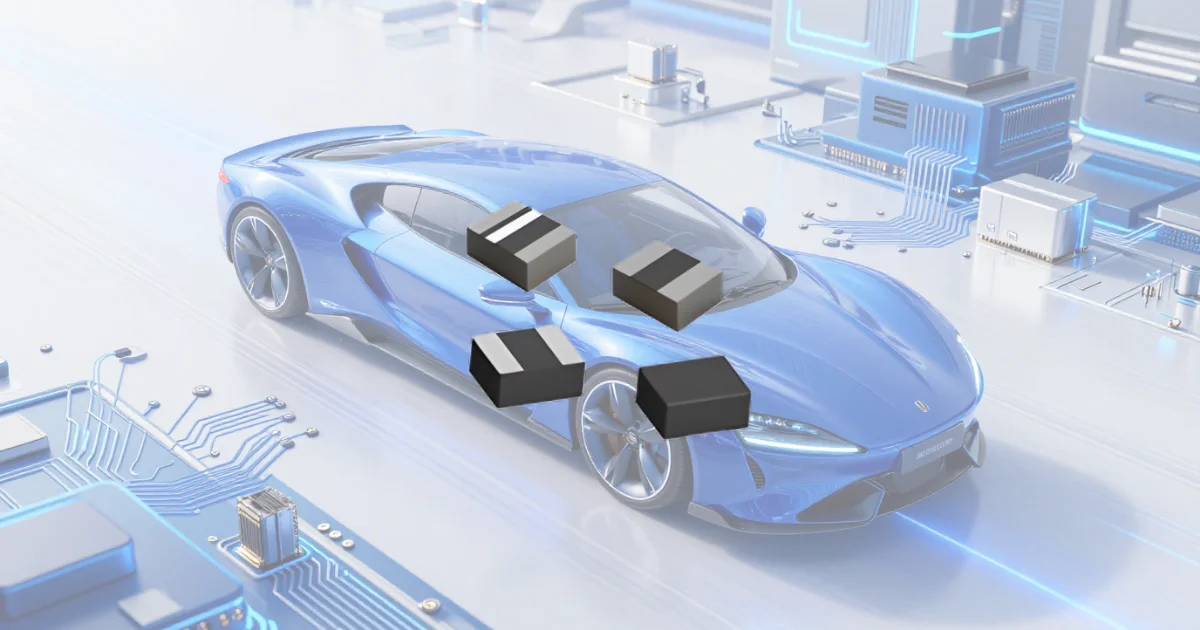 Power stages in compact designs often run into a familiar constraint. Once switching frequencies rise and current peaks stack up, the inductor becomes the limiting factor for both efficiency and thermal stability. Designers trying to tighten board density while keeping ripple and saturation under control usually end up trading footprint for margin. The latest IHLL-0806AZ-1Z, IHLP-0806AB-5A, IHLL-1210AB-1Z and IHLP-1210ABEZ-5A inductors from Vishay Intertechnology push that tradeoff in a different direction by shrinking package sizes without sacrificing current capability, temperature rating or stability under heavy load.
Smaller Packages That Maintain Current Handling
One of the most practical shifts in this release is the footprint reduction. The IHLL 0806 devices fit within a 2.0 mm by 1.6 mm outline, while the 1210 variants sit at 3.2 mm by 2.5 mm. In real power architectures, shaving even a millimeter from the inductor footprint can determine whether stages fit between connectors, thermal cutouts or RF keep out zones. Vishay’s comparison against the next smallest competing parts shows up to 64 percent area reduction in the 0806 class and around 11 percent in the 1210 class. What matters is that this reduction does not force a drop in current rating. Across the families the inductors handle typical saturation points that match or exceed larger devices, with some variants reaching beyond 9 A under certain test conditions.
Terminal Designs That Reflect Different Mechanical Constraints
Two terminal constructions support different use cases. The IHLL versions use bottom only terminations, which allow tighter land patterns in dense switching stages where space is at a premium. The IHLP devices include side plating that forms visible solder fillets during reflow. That detail is valuable in automotive nodes or industrial modules that see mechanical shock and need straightforward inspection. It also provides another anchor point when assemblies endure vibration or repeated thermal cycling. In practice this choice lets engineers match the mechanical profile to the environment without changing the core electrical behavior.
Magnetic Construction That Reduces Crosstalk And Noise
These inductors use a powdered iron composite body that encapsulates the windings. Eliminating air gaps helps maintain magnetic stability at high temperature while reducing stray field coupling into nearby components. This becomes critical in multi phase converters or compact RF sections where routing is already constrained. The soft saturation characteristic also helps keep the inductance curve predictable when current surges appear during startup, motor commutation or transient load steps. For designers building converters in tightly packed enclosures, this predictability often matters more than peak inductance because it dictates how the system responds during fast changes.
Thermal Ratings That Support Automotive And High Duty Cycle Systems
Two of the families meet AEC Q200 qualification and operate up to 165 degrees Celsius, which exceeds many composite inductors in similar sizes. Automotive braking controllers, ADAS sensor modules and engine control electronics often run at elevated ambient temperatures where thermal margins shrink quickly. The extended rating gives engineers more room to work with when placing inductors next to MOSFETs, regulators or SoCs that run warm under normal load. For consumer and industrial nodes the additional headroom reduces long term drift and helps maintain efficiency across a wider operating range.
Applications That Benefit From Size, Stability And Shielding
Different application classes map cleanly to the four product families. Bottom terminated IHLL devices suit SSD modules, CPUs, networking gear and compact DC DC converters where land pattern minimization is a priority. The IHLP devices fit better in environments that demand mechanical robustness such as automotive infotainment, LiDAR, braking controllers and instrumentation. Fully encapsulated construction and low acoustic noise also make them suitable for audio equipment, medical devices and precision instrumentation that rely on clean power rails. For engineers, the takeaway is that these inductors offer smaller footprints without forcing compromises in saturation behavior, DCR or thermal limits, which opens up more flexible layouts in space constrained designs.
Learn more and read the original announcement at www.vishay.com
You may also like