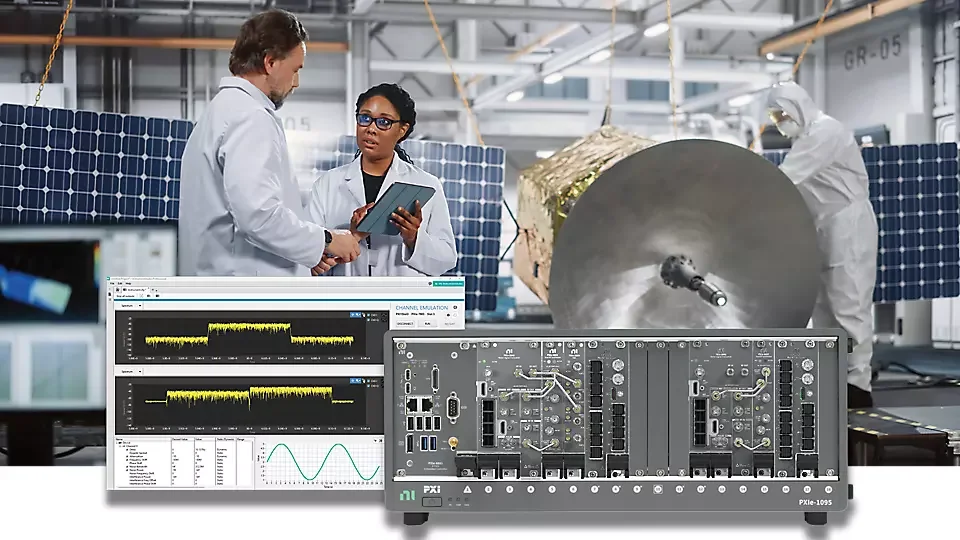
 Emerson’s NI CHESS platform brings a more advanced form of RF channel emulation into the lab for aerospace, satellite, and defense testing. Built to work with NI PXI Vector Signal Transceiver hardware, it recreates dynamic channel conditions in real time so engineers can validate difficult RF links under more realistic and repeatable conditions before testing moves into the field. NI CHESS is a high-fidelity RF channel emulation platform used to model the behavior of mission-critical communication links under changing signal conditions. In systems such as ground-to-orbit, ground-to-air, and airborne communications, that kind of validation matters because the RF path rarely behaves in a simple or stable way.
In a typical aerospace test environment, the challenge is not just verifying that a link works at all. It is verifying that it continues to work when motion, interference, fading, and path changes begin to overlap. Once that work is left too late, field testing starts carrying more risk than it should.
Bringing Harder RF Conditions Into A Repeatable Test Setup
The stronger point in this launch is the level of channel realism Emerson is aiming to bring into a controlled bench environment. According to the announcement, NI CHESS can stream Doppler shift, multipath fading, path loss, and interference in real time through FPGA co-processing and third-party scenario tools. Those impairments are not side details. They are often the conditions that expose weaknesses in a link budget, receiver behavior, or overall system robustness. That's where conventional lab validation can fall short. A simplified setup is useful for early-stage development and basic functional checks, but it does not always reproduce the changing RF behavior that defines real aerospace and defense operation.
Why This Matters For Aerospace And Defense Programs
Communication links in aerospace systems do not fail in neat or predictable ways. Performance can shift with movement, timing, geometry, blockage, and environmental variation, and those effects are not always easy to recreate consistently outside a dedicated test environment. Ground-to-air and ground-to-orbit paths are especially demanding because the test conditions themselves can keep changing while the link remains active.
A platform such as CHESS is valuable because it allows more of that complexity to be evaluated under controlled conditions. That doesn't remove the need for field testing, nor should it, but it can reduce how much late-stage field work has to carry in terms of risk, time, and cost.
Extending Existing NI PXI Test Infrastructure
Another practical detail is that CHESS fits into existing NI PXI RF infrastructure. That matters because test teams are far more likely to adopt a new validation tool if it extends the capability of the current lab rather than forcing a major rebuild. Emerson is clearly positioning CHESS as a way to increase test coverage while preserving prior investment in NI-based setups, which becomes more important as communication systems grow wider in bandwidth and more complex in behavior. Emerson describes the platform as multi-channel and wideband, which aligns with the direction many aerospace and satellite links are already moving.
Earlier Validation Usually Means Lower Risk
The real value of a platform like NI CHESS is straightforward. It gives engineers a better chance of identifying RF performance issues earlier, while test conditions are still controlled and design changes are still manageable. In aerospace and defense programs, that can make a meaningful difference to both schedule and cost.
Learn more and read the original announcement at www.ni.com
Technology Overview
NI CHESS is a software-based RF channel emulation platform that works with NI PXI Vector Signal Transceiver hardware. It recreates dynamic RF impairments including Doppler shift, multipath fading, path loss, and interference in real time for aerospace, satellite, and defense communication testing. Its role is to support repeatable lab-based validation of complex RF links before late-stage field testing.
Frequently Asked Questions
What is NI CHESS used for?
NI CHESS is used to emulate realistic RF channel conditions in the lab for aerospace, satellite, and defense communication testing.
Which impairments can NI CHESS emulate?
Emerson says NI CHESS can emulate Doppler shift, multipath fading, path loss, and interference in real time.
Does NI CHESS work with existing NI RF hardware?
Yes. Emerson says the platform works with NI PXI Vector Signal Transceiver hardware and integrates with existing NI PXI RF infrastructure.
You may also like