
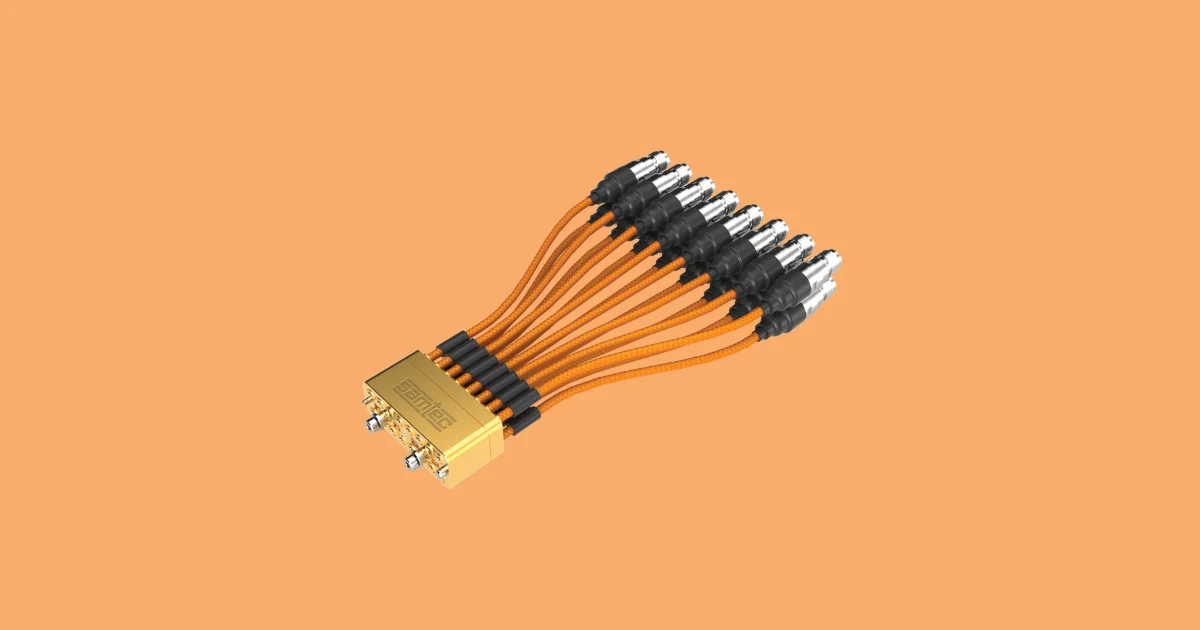
 224 Gbps PAM4 testing leaves very little room for waste in the signal path. Samtec’s BE71A Bulls Eye test assembly is built for that job, supporting measurements out to 71 GHz while keeping the connection close to the SerDes under test. It combines the company’s compression-mount interface with Nitrowave microwave cable, giving engineers a compact way to reach high-speed channels without stretching trace lengths across the board.
The BE71A is a phase- and amplitude-stable test assembly used for high-speed digital test, SerDes characterization, and automated test equipment. In a typical setup, it mounts directly to the board near the channel being evaluated, which helps cut trace length and the associated loss before the signal reaches the instrument.
A Shorter Path Into The Channel
That direct board connection is a big part of the product’s appeal. As signaling speeds climb, the test path itself becomes more of the challenge. Long PCB routes between the device under test and the measurement interface can eat into margin quickly, especially when working with PAM4 channels that already leave less room for error. By compression-mounting close to the SerDes, the BE71A gives engineers a cleaner way into the channel without giving up valuable board area to larger fixture structures.
Samtec also points out that some users are integrating these assemblies directly into the front panel of 224 Gbps test equipment such as bit error rate testers. That makes sense. Once a test interface becomes stable and compact enough, it stops being just a lab accessory and starts looking like part of the equipment architecture itself.
Phase Matching Is Central To The Design
Phase stability is one of the main technical points here. Samtec quotes 0.5 ps phase matching for the BE71A, which is a serious figure for this kind of application. At high frequencies, even small shifts between cable assemblies can affect timing alignment and measurement confidence, particularly when fixtures and cables are being repositioned during test work.
The use of Nitrowave cable is part of that story. Samtec says the cable was developed to maintain phase stability while the setup is adjusted, which matters because real high-speed test benches are rarely static. If the assembly moves and the phase behavior moves with it, repeatability starts getting harder to trust.
Avoiding A Forced Jump To 1.00 mm Hardware
Another useful point is the instrumentation side of the assembly. The BE71A uses a standard 1.85 mm connection, which means teams do not necessarily have to step up to 1.00 mm test equipment for 224 Gbps PAM4 work. That will not remove every limitation in a high-speed validation setup, but it does lower one of the barriers to getting into this class of testing.
That choice also says something about how the product is positioned. This is not just about absolute performance. It is also about keeping advanced testing more practical for engineers who are trying to extend existing lab capability instead of replacing a full chain of equipment.
Built For Dense Test And I O Layouts
The assembly supports microstrip, coplanar waveguide, and stripline PCB transmission with 50 ohm impedance, and Samtec offers configurations with 4 and 8 positions per row. That gives it flexibility for compact evaluation boards, dense test fixtures, and high-density multi-port panel and I O connections where board space is already under pressure.
Samtec specifies an operating temperature range of minus 65 C to plus 125 C, which fits the broader test and ruggedized environments the company often targets. The BE71A also sits within a larger Bulls Eye family that has expanded from early 20 GHz systems to versions supporting 40 GHz, 50 GHz, 70 GHz, 71 GHz, 90 GHz, and 130 GHz. In that context, this launch feels like a direct extension of a known test platform into the 224 Gbps generation.
Learn more and read the original announcement at www.samtec.com
Technology Overview
The BE71A is a 71 GHz Bulls Eye phase- and amplitude-stable test assembly for 224 Gbps PAM4 SerDes characterization. It uses Samtec’s Nitrowave cable, a 1.85 mm instrumentation connection, and a compression-mount board interface to support short, high-density test paths. It is available in 4- and 8-position-per-row configurations and supports 50 ohm microstrip, CPW, and stripline PCB transmission.
Frequently Asked Questions
What is the Samtec BE71A used for?
It is used for 224 Gbps PAM4 SerDes characterization, high-speed digital test, ATE, and dense multiport I/O test connections.
Does the BE71A require 1.00 mm test equipment?
No. Samtec says the assembly uses a standard 1.85 mm instrumentation connection, avoiding the need to move to 1.00 mm equipment for this use case.
What configurations are available for the BE71A?
Samtec lists versions with 4 and 8 positions per row, with support for single- or double-row formats depending on the application.
You may also like