
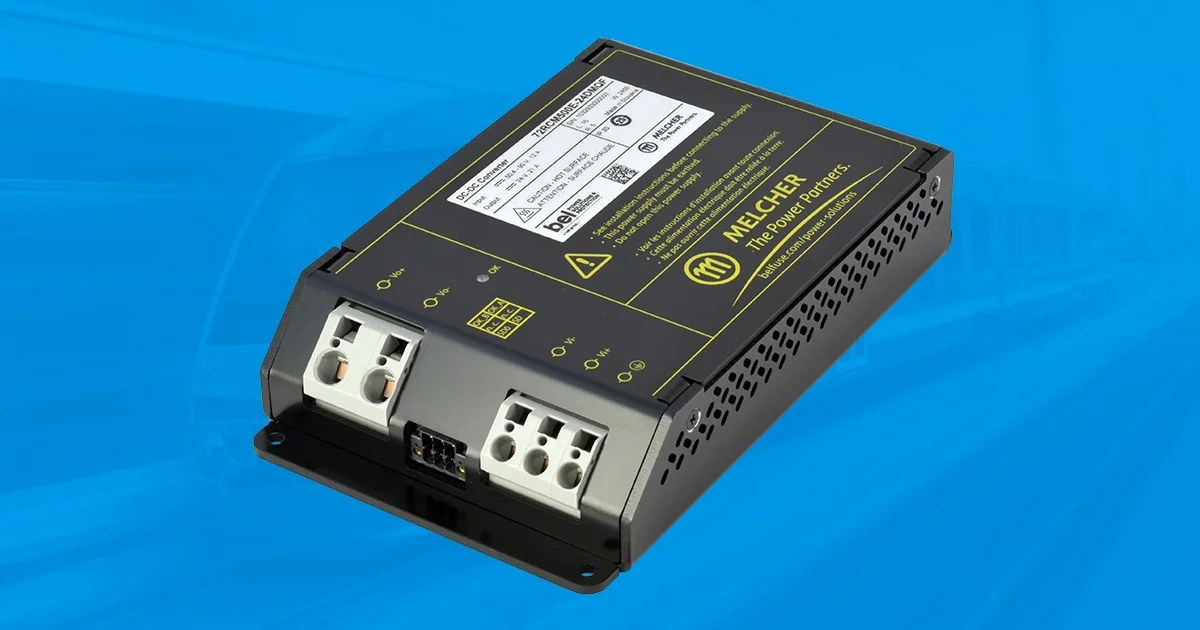
 Bel Fuse has introduced the RCM500E, a 500 W DC-DC converter designed for railway power systems where enclosure space, thermal behavior, and reliable restart performance all matter. It targets rolling stock equipment and arrives as the second generation of Bel’s 500 W railway supply family, with a noticeably smaller mechanical footprint and a simpler construction aimed at lower production cost. The RCM500E is a 500 W DC-DC power converter used for stepping railway battery voltages down to a regulated 24 V rail for onboard equipment.
That system context is important because these converters don’t sit in isolation. In rolling stock, they typically support control electronics, communications hardware, monitoring systems, and other onboard subsystems that need a stable low-voltage supply from a 72 V or 110 V battery bus. In those installations, space inside cabinets and equipment bays is often limited, so converter volume can be just as important as output power.
A Smaller 500 W Converter for Rail Platforms
Bel says the RCM500E occupies 830 cm³, putting it close to 60% smaller than comparable converters while still meeting EN 50155 requirements for railway applications. That gives designers more flexibility when working around crowded rolling stock assemblies, especially where multiple power stages, protection hardware, and I/O modules need to share the same mechanical space.
The converter is built as a chassis-mount unit with a closed housing and cooling openings. Bel also notes that the design has been optimized for high-volume manufacturing through a reduced through-hole component count and a simpler assembly flow. That may not change the way the converter is used in the field, but it does suggest that Bel has paid attention not only to electrical efficiency and packaging, but also to manufacturing practicality.
Input, Output, and Railway Operating Behavior
The RCM500E family is offered in versions for 72 V and 110 V railway battery systems, both with a 24 V output and 500 W power rating. Bel’s listed variants show a 72 V model with a 50.4 V to 90 VDC input range and a 110 V model with a 77 V to 137.5 VDC input range, with output current up to 21 A. That makes the unit suitable for standard onboard conversion duties where the main requirement is a robust 24 V supply from common railway battery rails.
One of the more useful details here is the focus on inrush behavior. Bel highlights low and short inrush currents, which helps reduce the chance of nuisance circuit breaker trips after supply interruptions. In rail systems, where brownouts, resets, and line disturbances are all real operating concerns, that kind of startup behavior can matter more than a headline efficiency figure on its own.
Protection and Power Management Features
The converter also includes low idle power consumption, which helps reduce unnecessary battery drain when equipment is not under full load. That is relevant in rail applications where auxiliary systems may remain powered for long periods and every watt of standby loss adds up across the vehicle.
For fault handling, Bel specifies constant current limitation along with overtemperature, overvoltage, overcurrent, and short-circuit protection with automatic recovery. Those are expected features in this class, but they are still central to how a railway converter earns its place in a system. Protection isn’t just about survival during a fault. It also affects how gracefully the wider platform recovers without requiring manual intervention.
Where the RCM500E Fits in Railway Design
The RCM500E is not trying to redefine railway power conversion. Its value is more practical than that. Bel has taken a familiar 500 W, 24 V railway converter format and made it smaller, easier to integrate, and better aligned with the mechanical and operational constraints of rolling stock platforms. For engineers working with 72 V or 110 V rail batteries, that combination of compact size, low inrush current, and built-in protection is probably the main story.
Learn more and read the original announcement at www.belfuse.com
Technology Overview
The Bel RCM500E is a 500 W chassis-mount DC-DC converter for railway and transportation systems. It converts 72 V or 110 V railway battery inputs to a 24 V output, with listed input ranges of 50.4 V to 90 VDC and 77 V to 137.5 VDC depending on model. The unit is designed for EN 50155 railway use and includes protection for overtemperature, overvoltage, overcurrent, and short circuit.
View the RCM500E Series datasheet.
Frequently Asked Questions
What is the RCM500E used for?
It is used to generate a regulated 24 V supply from railway battery systems in rolling stock and other transportation equipment.
What input voltages does the RCM500E support?
The series is available for 72 V and 110 V railway battery systems. Listed input ranges are 50.4 V to 90 VDC and 77 V to 137.5 VDC, depending on model.
What output does the converter provide?
The RCM500E provides a 24 VDC output at up to 500 W, with output current up to 21 A.
You may also like