 Recently, a new SBC has been released that utilizes RISC-V, making it a viable contender for Raspberry Pi solutions. What challenges do SBC face, what features does the new machine offer, and could it help establish RISC-V as a better alternative for future SBCs?
The Rising Challenges with Single Board Computers (SBCs)
While Single Board Computers, or SBCs, have existed for several years, it was the introduction of the Raspberry Pi that made this computing technology truly take off. The ever-increasing power of processors, greater amounts of RAM, and improvements in electronics helped to make these tiny machines highly popular with both makers and professionals alike.
Arguably, one of the most brilliant aspects of SBCs is the incredible amount of features that they pack into a very small package, which sees them often used in applications where space is restricted. For example, an IoT device may use an SBC as its primary controller (the “edge device”), instead of a microcontroller due to the additional processing power provided, the ability to run more complex code, and support for additional hardware.
However, there are numerous challenges faced with SBCs that make them less suited for certain applications where more power, expandability, or specific hardware support is required. One such challenge is that, because they are small, they are often restricted in what peripherals they can support, and what they are able to do.
For example, while the Raspberry Pi range of computers are ideal for many applications, their low-end graphics and poor video encoding capabilities can make them less suitable for demanding video streaming or media processing tasks. Furthermore, the rising requirements from modern operating systems (such as Windows and Linux), combined with the limited power capabilities of SBCs, sees many SBCs unable to support all mainstream features.
Another challenge faced with SBCs is the increasing price of key components such as RAM, and the resulting impact on the price of SBCs. Simply put, as SBCs are designed to be as cheap as possible, if the price of RAM (or any substantial part) increases, then either the SBC must suffer a price increase, or face reductions in capabilities to maintain prices.
These factors have started to push engineers away from SBCs, with some turning towards small form factor desktop PCs and even second-hand enterprise machines. Such machines can not only provide significantly better capabilities compared to SBCs, they also provide additional expansion slots (such as PCIe), are more easily expandable, and more readily available.
Finally, the reliance on technologies such as ARM can also see SBCs suffer from increased prices. As ARM requires licenses and royalties paid to ARM, SBC manufacturers will likely have to factor this into the final price, thereby increasing the price to end users.
New RISC-V SBC Challenges the Raspberry Pi V
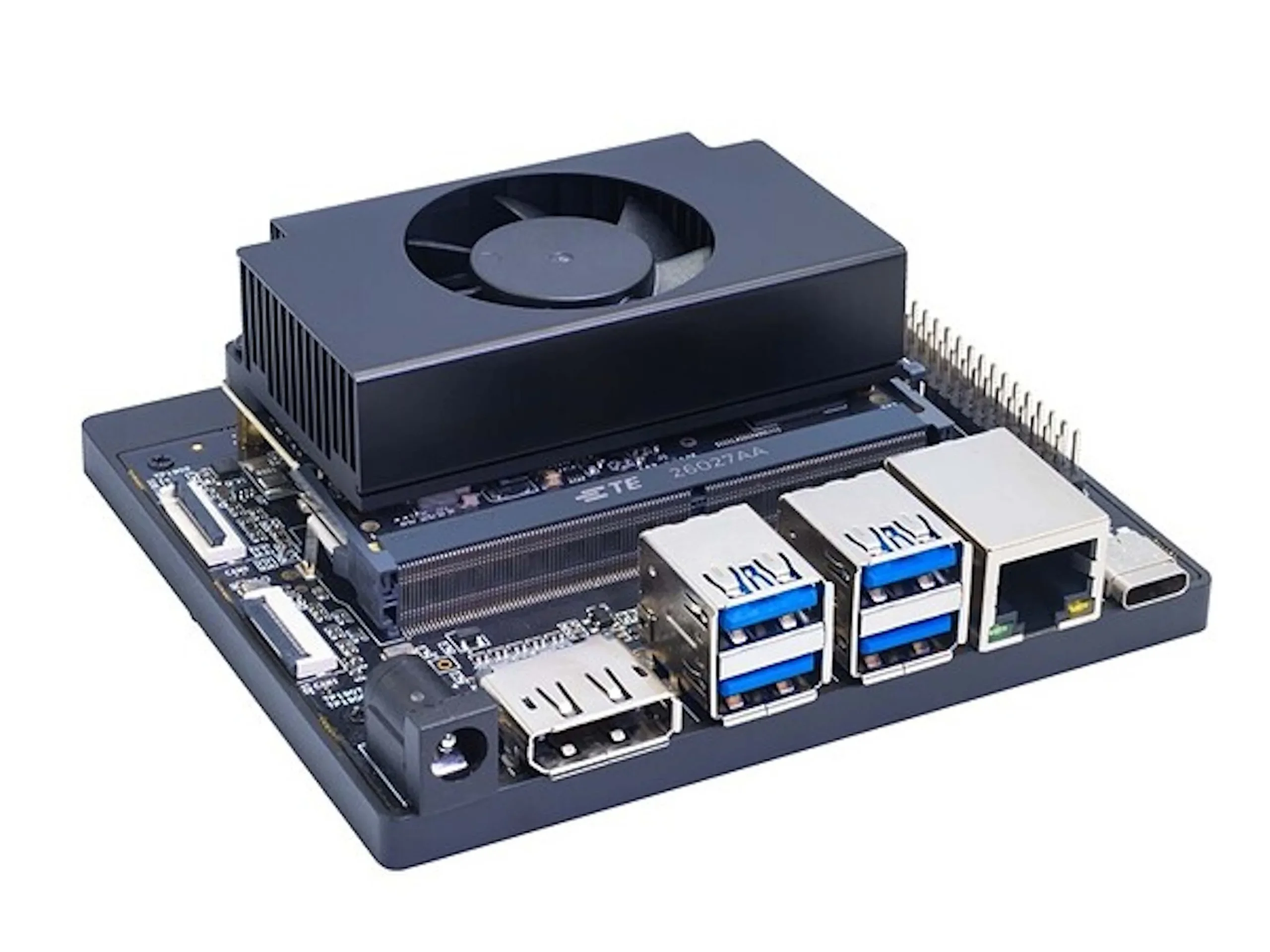
Recognising the numerous challenges faced with SBCs, and how RISC-V could soon dominate this industry, the Chinese manufacturer of the Banana Pi range of single board computers, has recently announced the development of the BPI-SM10, a new single-board computer that is being targeted at high-performance computing applications including AI workloads.
Unlike traditional SBCs which integrate all circuitry onto a single PCB, the new BPI-SM10 combines a compute module with a carrier board. While the compute module itself is entirely identical to the core compute unit, the carrier board exposes various ports including USB 3.0, Gigabit Ethernet, DisplayPort, MIPI-DSI, and multiple M.2 key slots.
What makes the new board particularly interesting is that, unlike the vast majority of SBCs on the market, it is based on the RISC-V instruction architecture, which is less common in mainstream SBCs and offers a new level of openness and customizability compared to ARM-based solutions.
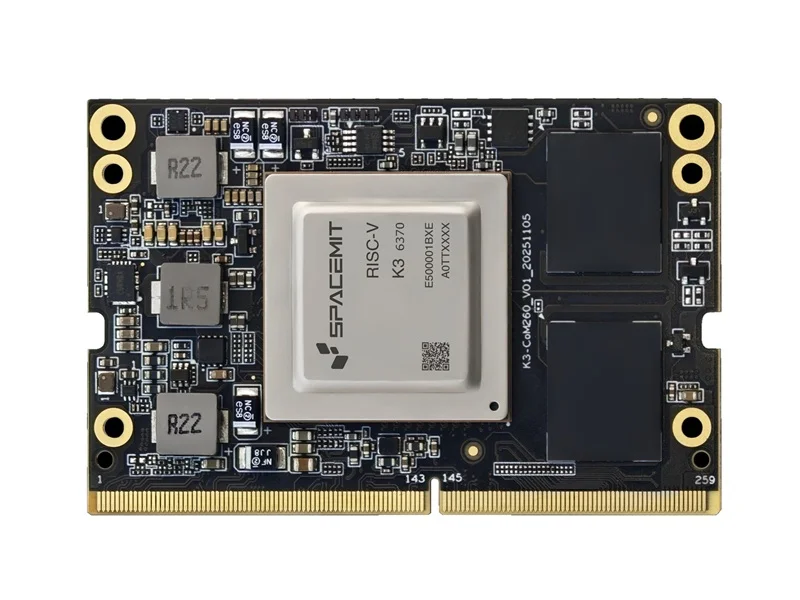
The new board’s CPU is the SpacemiT K3 which integrates eight X100 compute cores clocked up to 2.4GHz, and 8MB of L2 cache. These cores are arranged into two clusters, with each cluster having four cores, and all cores in the cluster sharing a unified L2 cache. The SpacemiT K3 also integrates 8 A100 AI cores that provide up to 60 TOPS of AI performance, and the entire system supports LPDDR5 memory in 8GB, 16GB, or 32GB configurations, with total power consumption ranging from 18W to 35W.
The board also features a GPIO header for connecting to additional modules, making it compatible with standard SBC peripherals and expansion options. This modular design, along with support for multiple storage and display interfaces, positions the BPI-SM10 as a flexible platform for both development and deployment in AI or edge computing scenarios.
While the BPI-SM10 is still in the prototype stage, it is expected to compete with AI-focused SBCs such as those offered by Nvidia in their Jetson range of products. However, whether the new SBC will be successful against the Nvidia range of products remains to be seen, as such products are already being deployed in commercial applications.
Why RISC-V Is Going To Be the Future
RISC-V is quickly becoming a well-known ISA, and for good reason; the open nature of the ISA allows for anyone to create their own RISC-V compatible CPU, and that means that any code written for one RISC-V CPU will work on any other RISC-V CPU.
But it’s not just the fact that it’s an open ISA that makes it ideal for use in SBCs, it’s that there are no licenses or royalties associated with RISC-V. This means that anyone can create their own RISC-V CPU and see no challenges from the RISC-V foundation when releasing their product to the public. Thus, new companies could easily start producing SBCs and other compute solutions entirely independent to others.
In the case of SBCs, it is clear that the future of SBCs lies in RISC-V, and this can be clearly observed with the numerous SBCs that are starting to adopt the new instruction architecture. But not only is RISC-V helping to drive SBC development, the reverse is also true whereby the popularity of RISC-V in SBCs is helping to accelerate its development and deployment.
However, if SBC developers decide to go the extra mile and create their own RISC-V compatible CPUs, this could see SBCs become even more dominant in the computing landscape. By keeping the manufacturing of the CPU entirely internal to the company, not only does the SBC manufacturer have full control over the CPU, but will not have to pay royalties or fees to other companies (such as ARM).
This approach helps keep development costs lower and encourages more innovation in hardware design, as manufacturers are not limited by the constraints of proprietary ISAs or licensing agreements. It also allows for the addition of custom instructions or accelerators tailored to specific workloads, such as AI, machine learning, or data processing.
Not only does this help to keep SBC designs unique, it also reduces the cost to end-users, thereby making SBCs more economical. Additionally, the use of customised RISC-V CPUs also allows for SBCs to be specifically designed with acceleration tasks in mind, whether its AI, video processing, or floating-point calculations.
Overall, RISC-V is certainly going to be the future of SBCs, and it won’t be long before ARM becomes dethroned in this area of computing.
You may also like