
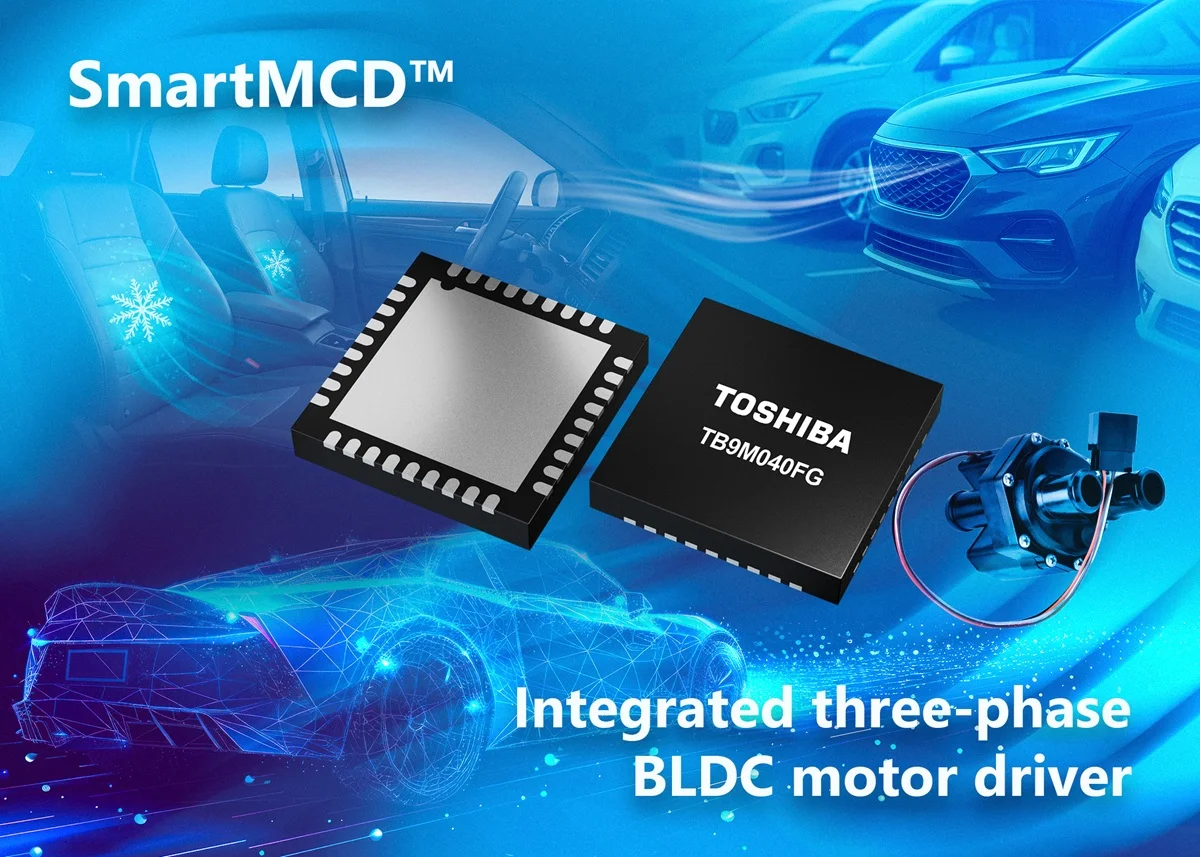
 Toshiba has started sampling the TB9M040FTG, a SmartMCD device that combines a 32-bit MCU, gate driver, and integrated MOSFETs into a single package for compact automotive BLDC motor control systems below 40 W. The device is aimed at smaller three-phase motor applications such as HVAC dampers, electric valves, pumps, fans, and grille shutters where ECU size and component count are becoming harder to manage as more actuators move into the vehicle.
The TB9M040FTG is a three-phase BLDC motor control device with integrated power MOSFETs and an Arm Cortex-M23 MCU designed for direct control of compact automotive motors. Toshiba has packaged the controller, driver stage, LIN communication, and power management functions into a 6 mm × 6 mm VQFN36 package, reducing the amount of external circuitry normally required around smaller automotive motor systems. That becomes increasingly relevant in distributed automotive systems where dozens of low-power actuators now sit throughout the vehicle inside airflow systems, thermal management hardware, shutters, and valve assemblies where PCB area and enclosure size are limited.
Integrated Motor Control for Sub-40 W Automotive Loads
The TB9M040FTG combines several functions that would traditionally be separated across multiple devices. Alongside the Arm Cortex-M23 core and flash memory, Toshiba integrates a three-phase motor driver with built-in MOSFETs, a LIN transceiver, and a 5 V supply rail for external sensors or optional components.
For lower-power automotive motor systems, reducing the number of external ICs also simplifies routing, power distribution, and thermal management around the motor controller board. In compact actuator assemblies, the PCB often sits directly beside the motor housing or inside mechanically constrained enclosures where airflow is limited and connector placement becomes restrictive.
The device targets systems operating below 40 W, a range that covers a large number of small automotive motors increasingly replacing mechanical or pneumatic subsystems.
Vector Engine Accelerates FOC Processing
One of the more important architectural details is Toshiba’s integrated Vector Engine co-processor. The hardware accelerator is designed to reduce the computational load associated with field-oriented control while shortening FOC cycle times.
In small motor-control MCUs, FOC processing can quickly consume available CPU bandwidth once communication handling, diagnostics, and safety monitoring are added into the same controller. Offloading parts of the control loop to dedicated hardware helps reduce the amount of software overhead needed to maintain motor response and timing consistency.
The device also supports sensorless square-wave control using back electromotive force detection, avoiding the need for separate position sensors in applications where cost and wiring complexity need to stay low.
Built for Automotive Safety and Reliability Requirements
The TB9M040FTG is qualified to AEC-Q100 Grade 0 and is ASIL-B capable for automotive systems requiring medium-level functional safety support. Protection features integrated into the device include undervoltage, overvoltage, and overcurrent detection alongside thermal shutdown and charge pump monitoring. Toshiba also includes drain-source voltage monitoring for both the high-side and low-side MOSFETs, allowing the controller to monitor switching behavior and fault conditions internally.
By integrating the MCU, MOSFETs, communication interface, and protection circuitry into a single package, Toshiba is clearly targeting compact automotive actuator systems where reducing ECU size matters almost as much as motor efficiency itself.
Learn more and read the original announcement at www.toshiba.semicon-storage.com
Technology Overview
The Toshiba TB9M040FTG is an automotive SmartMCD motor-control device integrating a 32-bit Arm Cortex-M23 MCU, three-phase BLDC motor driver, MOSFETs, LIN transceiver, and power management circuitry into a 6 mm × 6 mm VQFN36 package. The device supports sub-40 W automotive BLDC motor applications and includes hardware acceleration for field-oriented control through Toshiba’s Vector Engine co-processor.
Frequently Asked Questions
What applications is the TB9M040FTG designed for?
The device targets compact automotive BLDC motor systems including HVAC dampers, electric valves, pumps, fans, and grille shutters.
Does the TB9M040FTG support sensorless motor control?
Yes. The device includes back electromotive force detection for sensorless square-wave BLDC motor control.
What safety standards does the device support?
The TB9M040FTG is AEC-Q100 Grade 0 qualified and ASIL-B capable for automotive applications requiring medium functional safety support.
You may also like