 As RISC-V continues to become a more viable platform, Chinese manufacturer Firefly has recently released a new server rack, packed with 128 RISC-V modules and as many as 1024 CPU cores. How has RISC-V risen over the past few years, what has Firefly launched, and why does this signal a new era in server computing?
How Has RISC-V Risen Over the Past Few Years?
For the longest time, the world was dominated by two main processor architectures, x86/x64 and ARM. While Intel architectures were predominately used in desktop and servers, ARM found itself used in both mobile and embedded systems. But no matter the application, the dominance of the two processor architectures effectively prevented customers from having any choice whatsoever.
This is where RISC-V comes in, and its rise over the past few years is finally starting to see a shift in the nature of computation itself. The open-source nature of the instruction set allows engineers to design their own cores, and so long as they stick to the ISA as laid out in the RISC-V documentation, then they will be able to run any RISC-V code targeted to that ISA.
While RISC-V is still in its infancy, it has managed to spark massive amounts of interest, and has even started to become a real threat to established companies such as Intel and ARM. One country in particular that has massively taken advantage of RISC-V is China, where access to the latest technologies is increasingly becoming restricted.
But the rise of RISC-V isn’t just that it is free from licensing and royalties; it is also helping to open up new business opportunities to engineers looking to create their own processors. Of course, this has resulted in numerous custom SoCs and SoMs making their way to the market, but one area in particular that is seeing large amounts of attention is datacentres and supercomputers.
Chinese Manufacturer Firefly Announces RISC-V Server with 128 RISC-V Modules
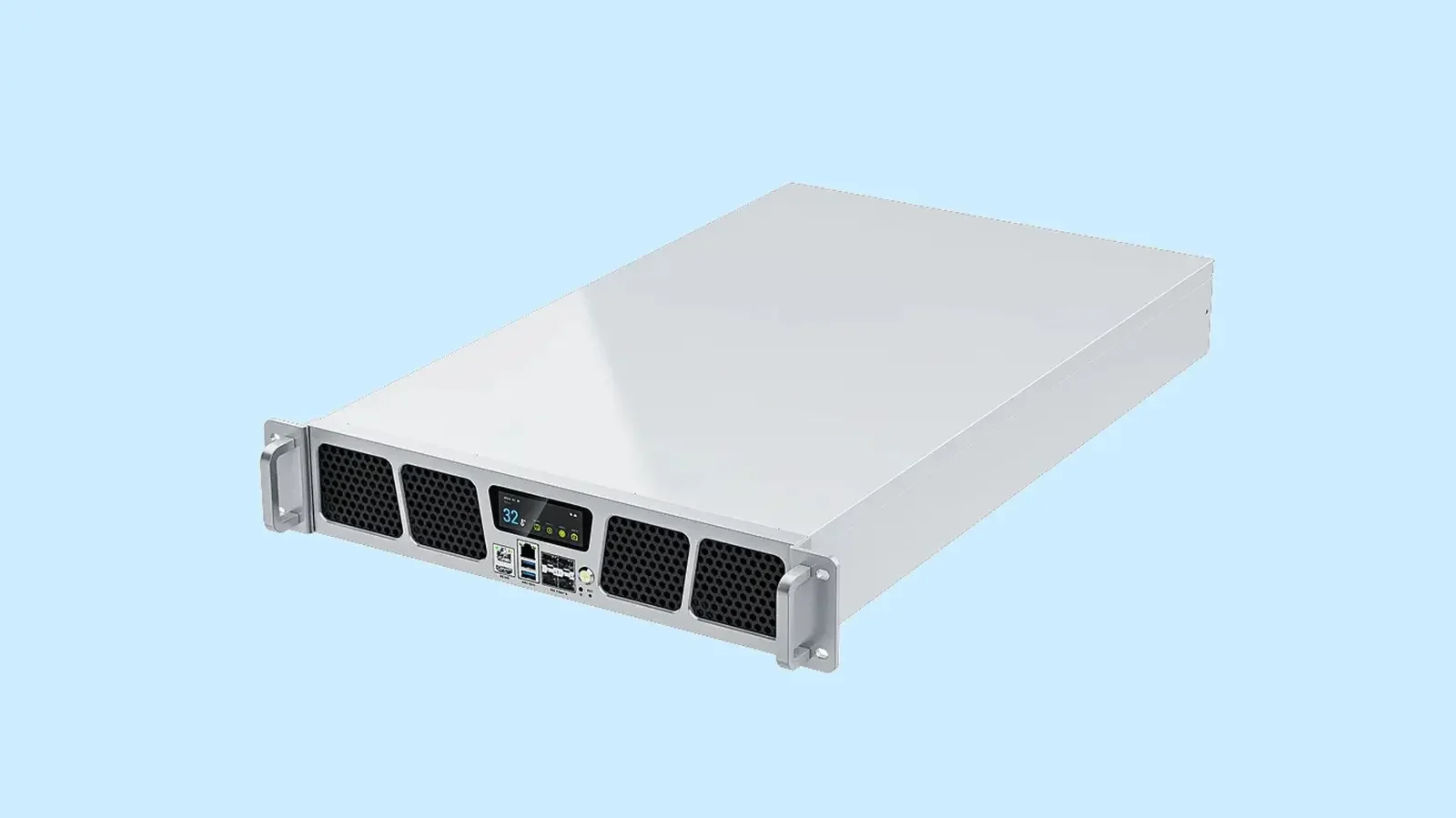
Recently, a Chinese brand called Firefly (T-Chip Intelligent Technology) has been teasing a rack server built around their range of modular compute boards that utilise the RISC-V instruction set. Now, the server has been officially announced to the public, and will be made available for customers shortly, with an expected price tag of around €34,150.
The new server, called the CSC2-N48SPK3, integrates 48 RISC-V compute modules that each use an eight-core SpacemiT K3 processor with 16 GB of LPDDR5 RAM. This results in a total CPU power of 384 cores, and a combined RAM storage of 768 GB.
However, it is also possible for the new server to be configured with a greater RAM size, but this will come at an additional cost. Interestingly, the new server also utilises a separate compute module based on an ARM core from Rockchip, but this is used for remote management instead of generic processing.
The ability to remotely manage the server is provided by an onboard BMC (Baseboard Management Controller), and the combination of the ARM core and RISC-V cores makes the new server highly versatile. But this isn’t the only server that Firefly is working on; they are also working on a much larger version that will integrate as many as 128 compute modules.
The larger version, called the CSD2-N128, can scale up to 128 compute modules using ARM or RISC-V processors from Rockchip or SpacemiT, and is stated to be compatible with mainstream Linux distributions, but this is yet to be confirmed. The server also integrates 4 10Gbit ethernet ports, but exactly how networking is distributed amongst the 48 modules remains unclear.
One server that comes close to what Firefly is planning to offer is the Netra XVR System from Netra, but this only supports up to 64 cores, and doesn’t integrate the same number of network ports.
Furthermore, the SpacemiT K3 is a RISC-V device that is one of the first to conform to the RVA23 specification. This means that it should work with mainstream Linux distros such as Ubuntu 24.04. However, as the Firefly server has yet to be released, there is no evidence of this operating with any Linux distribution.
Why Does this New Server Signal a Shift in Server Technologies?
If there is one fact that has been made abundantly clear over the past few years, it’s that Intel and ARM hold far too much power over the industry, and this can often restrict what companies are able to do. However, the introduction of RISC-V into the engineering community is undoubtedly going to change the face of computing forever.
Not only does RISC-V break down the barriers faced by companies and governments when trying to create new processor technologies, but it also provides smaller businesses and researchers with far greater opportunity. For example, the new Firefly server is ideal for large distributed computing systems where the number of cores on a single processor is irrelevant. As such, it is possible to create massive server setups with thousands of cores all working in parallel with each other.
It is very likely that Intel and ARM will continue to dominate the field of computing, but considering that Intel is doing virtually nothing in the field of high-density cores, and ARM is notorious for its licensing practices, it is clear that RISC-V presents engineers with the most viable solution for the future.
You may also like