
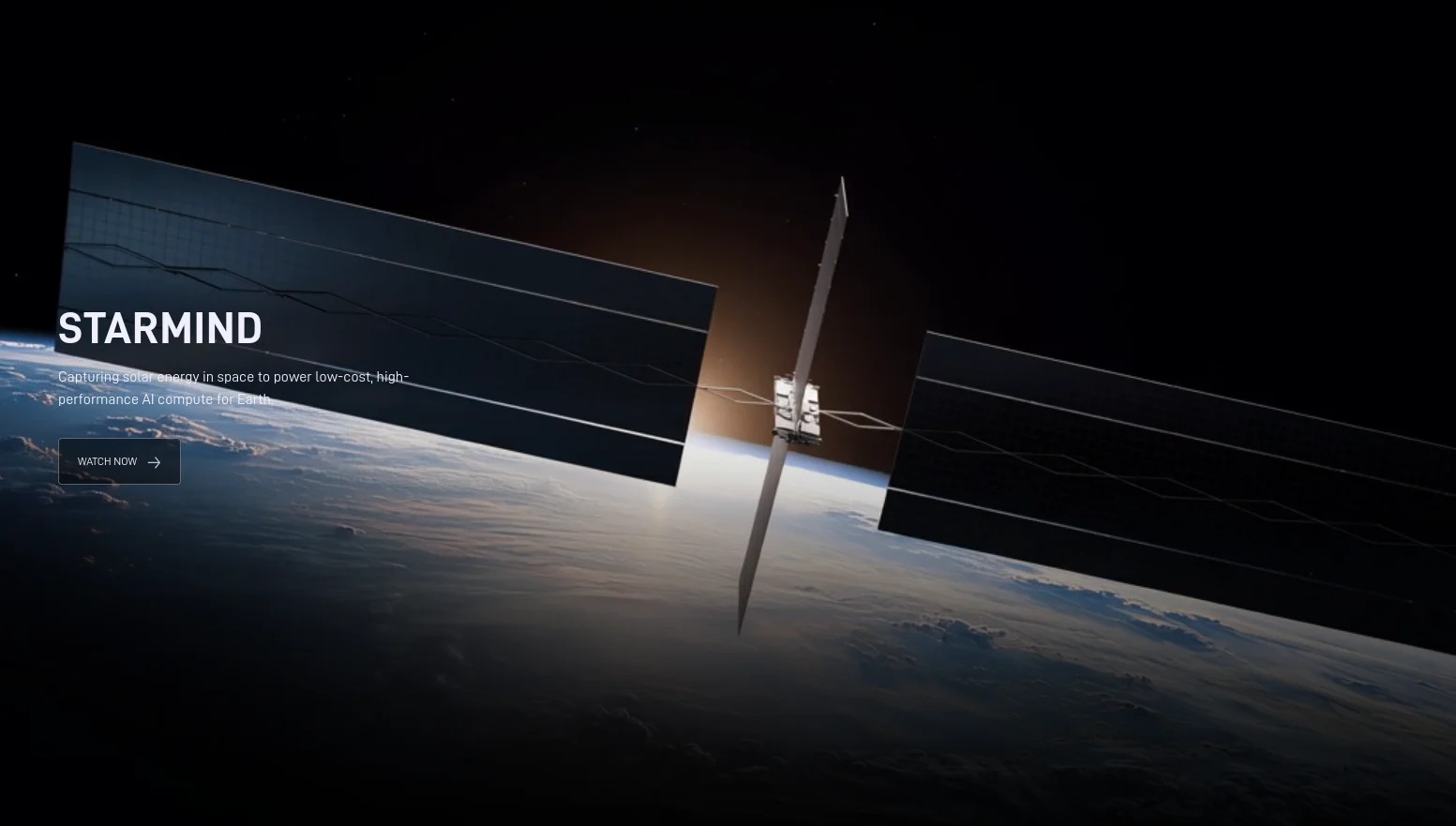
 Recently, SpaceX revealed their design concept for Starmind, satellites that do AI compute in space. However, as expected, the revealed data shows that the proposed system is beyond sanity while demonstrating how terrestrial datacenters are far more efficient.
SpaceX Reveals Starmind Design Concepts
Recently, SpaceX officially revealed technical details regarding its Starmind orbital data centre concept, which was first announced in 2022. Unlike Starlink satellites, which primarily provide communications services, AI1 satellites are designed to perform AI computing directly in orbit. The system would use high-bandwidth laser links to receive workloads from Earth, process AI tasks onboard, and then transmit completed results back to ground stations.
Each AI1 satellite is designed to house AI accelerators from multiple vendors, providing approximately 120 kW of continuous computing power, with peaks of up to 150 kW. According to SpaceX, this would be comparable to a modern AI server rack. Considering each satellite is expected to be around 20 metres tall with a 70 metre solar array span, these would be some of the largest computing platforms ever deployed into orbit.
Power would be supplied through large solar arrays, allowing the satellites to operate without access to terrestrial infrastructure such as electrical grids, power lines, or fuel supplies. Operating in space also provides continuous access to sunlight, avoiding the day-night cycle experienced by ground-based solar installations.
To cool the onboard AI hardware, SpaceX proposes a large liquid-cooled radiator system with approximately 110 m² of surface area. The system would circulate coolant through radiator panels, allowing heat generated by the processors to be rejected directly into space through thermal radiation. The design would also need to protect these components from the harsh environment of orbit, including micrometeoroid impacts and long-term exposure to radiation.
According to SpaceX, the combination of abundant solar power and the cold vacuum of space could enable high-performance orbital computing. However, questions remain regarding the practical efficiency of such systems, particularly when compared with the scale and simplicity of terrestrial datacentres.
SpaceX plans to launch the first three AI1 prototypes in early 2027. Two of these satellites would be deployed into approximately 600 km orbits, while the third would use a different orbital configuration. The company expects future production versions to be manufactured at the Gigasat facility currently being constructed in South Texas.
How This Revelation Shows Absolute Insanity
It is somewhat surprising that a concept like this has been presented with such confidence, with some viewing it as the future of computing. However, when looking at the published specifications, the practicality of the idea becomes seriously questionable.
To start, the computing power provided by an AI1 satellite is roughly equivalent to a modern AI server rack. Not an entire datacentre, not a complete row of racks, but a single rack at most. Modern AI facilities are already consuming hundreds of kilowatts, with large-scale datacentres requiring megawatts of power. With such a satellite, SpaceX is effectively proposing to launch the computing equivalent of one rack into orbit.
The next major issue is maintenance. Servers require regular servicing, replacement of failed components, and upgrades as newer hardware becomes available. On Earth, replacing a failed server is a relatively simple process as engineers can readily get access to perform required maintenance while also rapidly being able to install new units. In orbit, repairing or upgrading hardware becomes significantly more complicated, potentially requiring an expensive servicing mission or complete satellite replacement.
The cost of launching such a platform also creates a major problem. To achieve the same amount of computing power as a terrestrial datacentre, an enormous number of AI1 satellites would need to be deployed. The cost and complexity of launching, operating, and maintaining thousands of orbital computing platforms would be vastly higher than simply building another datacentre on Earth.
While space does provide some advantages (such as abundant solar energy), Earth already has far better advantages. Land, electricity, water, and physical access are all readily available and expanding a terrestrial datacentre can be as simple as adding another rack, whereas expanding an orbital datacentre requires manufacturing and launching an entire spacecraft.
There is also the issue of latency. Even in low Earth orbit, communication delays between ground stations and orbital processors would make many real-time applications impractical. There may be niche uses where satellites process data before transmitting it back to Earth, such as reducing the amount of information sent from remote spacecraft. However, this represents a very small market compared with the wider AI industry.
So how projects like this continue to receive funding continues to allude me. Engineers should always push the boundaries of what is possible, and space-based computing is certainly an interesting concept. However, the current design appears to be solving a problem that terrestrial infrastructure already solves far more efficiently.
More importantly, resources spent developing orbital AI datacentres could arguably be directed towards other long-term space goals. SpaceX is still working towards future lunar and Mars ambitions, and developing practical infrastructure for those missions would appear to provide a much clearer benefit.
If anything, the Starmind concept clearly shows the growing pressure for SpaceX to discover new revenue streams beyond Starlink and government contracts. While the company has repeatedly demonstrated impressive engineering capabilities, not every ambitious project will necessarily translate into a practical or economically viable product.
You may also like