
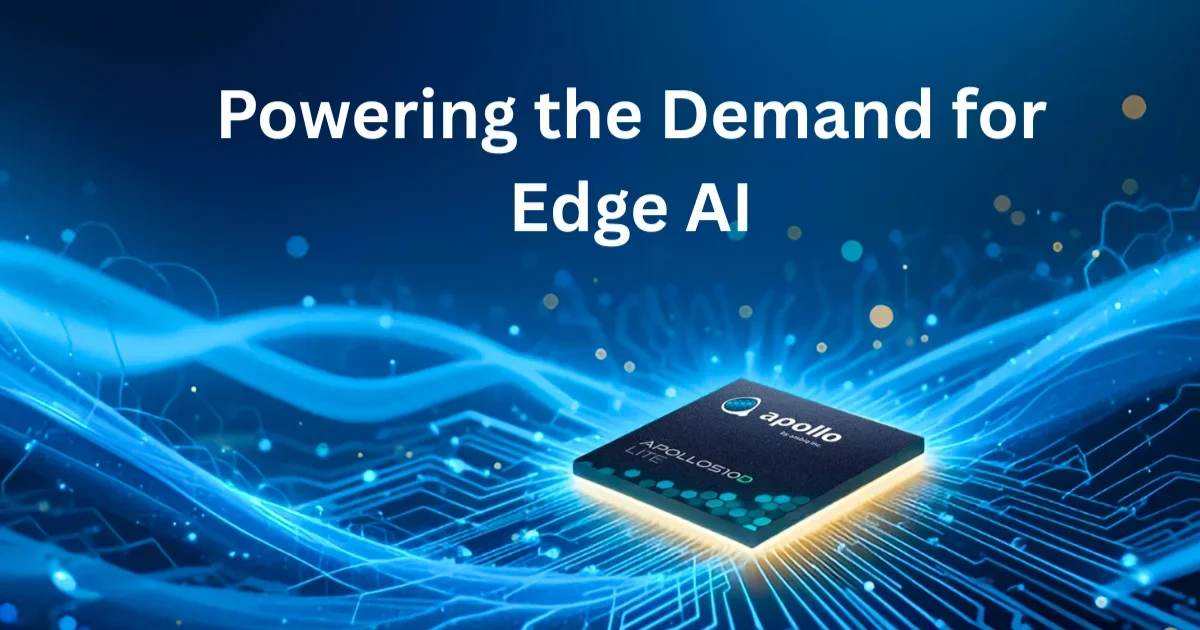
 Ambiq has announced the release to market (RTM) of its Apollo330 Plus and Apollo510 Lite system-on-chip (SoC) series. The six production-ready devices are designed for battery-powered edge AI applications including wearables, hearables, AR devices, digital health monitors, and industrial sensors.
The new family includes the Apollo330 Plus, Apollo330B Plus, Apollo330M Plus, Apollo510 Lite, Apollo510B Lite, and Apollo510D Lite. Built on Ambiq's SPOT (Subthreshold Power Optimized Technology) platform and powered by Arm Cortex-M55 processors with Helium technology, the devices combine ultra-low-power operation with integrated AI processing, wireless connectivity, and graphics capabilities.
Cortex-M55 Platform for Edge AI
The Apollo330 Plus and Apollo510 Lite series integrate Arm Cortex-M55 processors with Helium technology to accelerate AI inference on battery-powered devices. According to Ambiq, the devices deliver up to 16× higher performance, lower latency, and up to 30× better AI energy efficiency than previous-generation Cortex-M-based solutions.
The series also integrates AI acceleration capable of up to 8 MAC operations per cycle, together with up to 2 MB SRAM, 2 MB embedded NVM, and large instruction and data caches for on-device AI workloads.
Wireless, Graphics and Always-On Operation
Wireless variants include a 48/96 MHz Arm Cortex-M4F network processor supporting Bluetooth Low Energy, Bluetooth Classic, LE Audio, and Auracast. The Apollo330M Plus will also support Matter and Thread through a planned over-the-air software update.
The Apollo510 Lite devices integrate a 2D/2.5D GPU, vector graphics acceleration, and Ambiq's graphiqSPOT graphics engine for low-power display applications. An ultra-low-power PDM interface supports always-on voice applications while maintaining low system power consumption.
Security and Memory
The Apollo330 Plus and Apollo510 Lite series incorporate Ambiq secureSPOT 3.0 using Arm TrustZone technology. Security features include support for secure boot, secure firmware updates, and hardware-based protection of sensitive data.
The multi-core architecture separates application and network processing to maintain wireless performance while reducing overall power consumption.
Availability
The Apollo330 Plus and Apollo510 Lite series are available now through Ambiq's eStore and authorised distributors.
Learn more and read the original announcement at the Ambiq website.
Technology Overview
Edge AI SoCs combine microcontroller functionality with dedicated AI acceleration, memory, wireless connectivity, and security to enable machine learning directly on battery-powered devices. Running AI workloads locally reduces latency, lowers power consumption associated with wireless data transfer, and allows devices to continue operating without relying on cloud connectivity.
Frequently Asked Questions
What processor architecture do the new SoCs use?
The Apollo330 Plus and Apollo510 Lite series are based on Arm Cortex-M55 processors with Helium technology.
Which applications are these SoCs designed for?
The devices target wearables, hearables, AR hardware, digital health monitors, industrial sensors, and other battery-powered edge AI products.
What wireless standards are supported?
Wireless variants support Bluetooth Low Energy, Bluetooth Classic, LE Audio, and Auracast, while the Apollo330M Plus is planned to support Matter and Thread through a future OTA update.
You may also like