
Toshiba Introduces 64 GT/s MUX/DEMUX Switches
Toshiba has introduced the TDS5B212MX and TDS5C212MX high-speed MUX/DEMUX switches, supporting differential signals up to 64 GT/s with 29 GHz and 34 GHz bandwidths for PCIe 6.0 and USB4 Version 2.0.
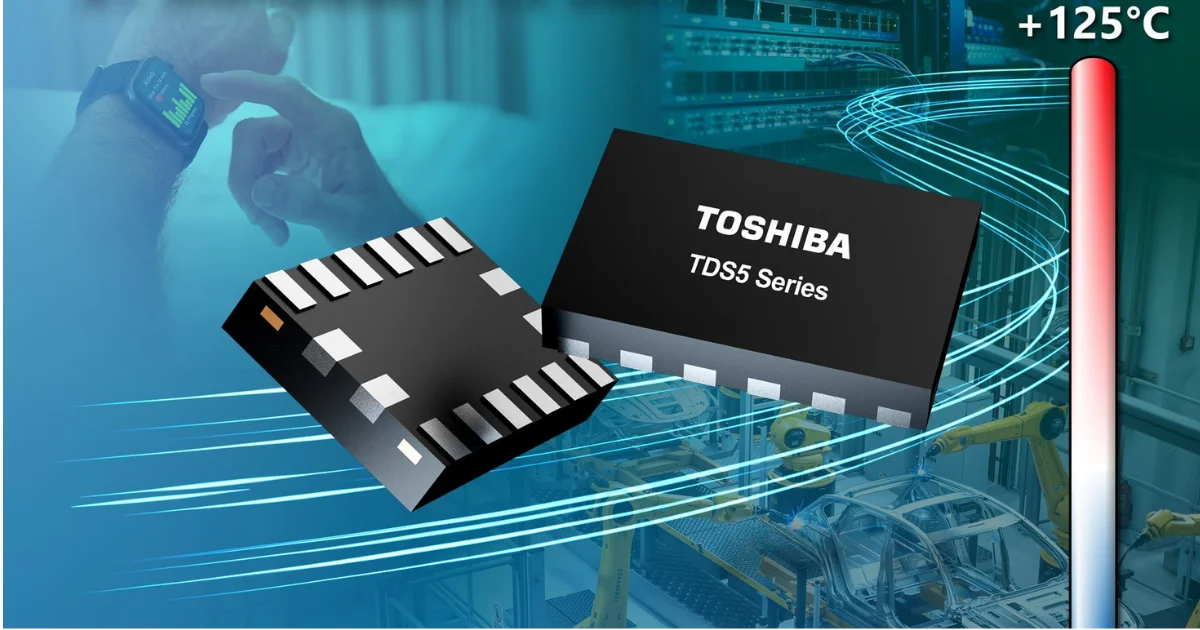
Both switches are manufactured using Toshiba’s TarfSOI process and are intended for routing high-speed differential signals in servers, industrial test equipment, robots, and related systems. They also operate from -40°C to +125°C.
29 GHz and 34 GHz Differential Bandwidth
The TDS5B212MX has a typical -3 dB differential bandwidth of 29 GHz, while the TDS5C212MX increases this to 34 GHz. Toshiba says the wider bandwidth is intended to limit signal distortion during high-speed data transmission.
The two devices can operate as either 2-input/1-output MUX switches or 1-input/2-output DEMUX switches. Supported high-speed interfaces include PCIe 6.0, USB4 Version 2.0, CXL 3.x, Thunderbolt 5, and DisplayPort 2.0, with backward compatibility for earlier interface generations.
This allows one differential interface to be switched between separate signal paths without changing the basic MUX/DEMUX function.
Pin Layout and Signal Path Length
Toshiba has optimized the pin layouts of both devices for high-frequency operation. The TDS5C212MX goes further by minimizing signal path length through the device. According to Toshiba, the shorter path reduces reflections and transmission losses. This is the main physical distinction highlighted for the 34 GHz TDS5C212MX as signal rates reach 64 GT/s.
The switches are based on Toshiba’s proprietary silicon-on-insulator TarfSOI process. The company uses the process for the high-frequency switching characteristics required by the two devices.
XQFN16 Package and 125°C Operation
Both switches are supplied in a 16-pin XQFN package measuring 2.4 mm × 1.6 mm × 0.4 mm. The small package is intended for high-density layouts where board area and signal routing are constrained.
The specified operating temperature range is -40°C to +125°C. This extends the devices into industrial equipment while retaining the compact package used for dense high-speed designs.
The TDS5B212MX and TDS5C212MX are intended for servers, industrial testers, robots, and other equipment using high-speed differential interfaces.
Learn more and read the original announcement at the Toshiba Electronics website.
Technology Overview
The Toshiba TDS5B212MX and TDS5C212MX are bidirectional 2:1 MUX and 1:2 DEMUX switches for differential signals up to 64 GT/s. Manufactured using Toshiba’s TarfSOI process, they provide typical -3 dB differential bandwidths of 29 GHz and 34 GHz respectively, support PCIe 6.0 and USB4 Version 2.0, and operate from -40°C to +125°C.
Frequently Asked Questions
What is the bandwidth of the Toshiba TDS5B212MX and TDS5C212MX?
The TDS5B212MX has a typical -3 dB differential bandwidth of 29 GHz. The TDS5C212MX has a typical -3 dB differential bandwidth of 34 GHz.
Which high-speed interfaces do the Toshiba switches support?
The devices support differential interfaces up to 64 GT/s, including PCIe 6.0, USB4 Version 2.0, CXL 3.x, Thunderbolt 5, and DisplayPort 2.0. They are also backward compatible with earlier interface standards.
What is the operating temperature range?
Both the TDS5B212MX and TDS5C212MX operate from -40°C to +125°C.
Related news
More from Toshiba
Keep up with the components and technology shaping electronics.
Join the club for member features, engineering discussion and easier access to the latest Component Club content.