
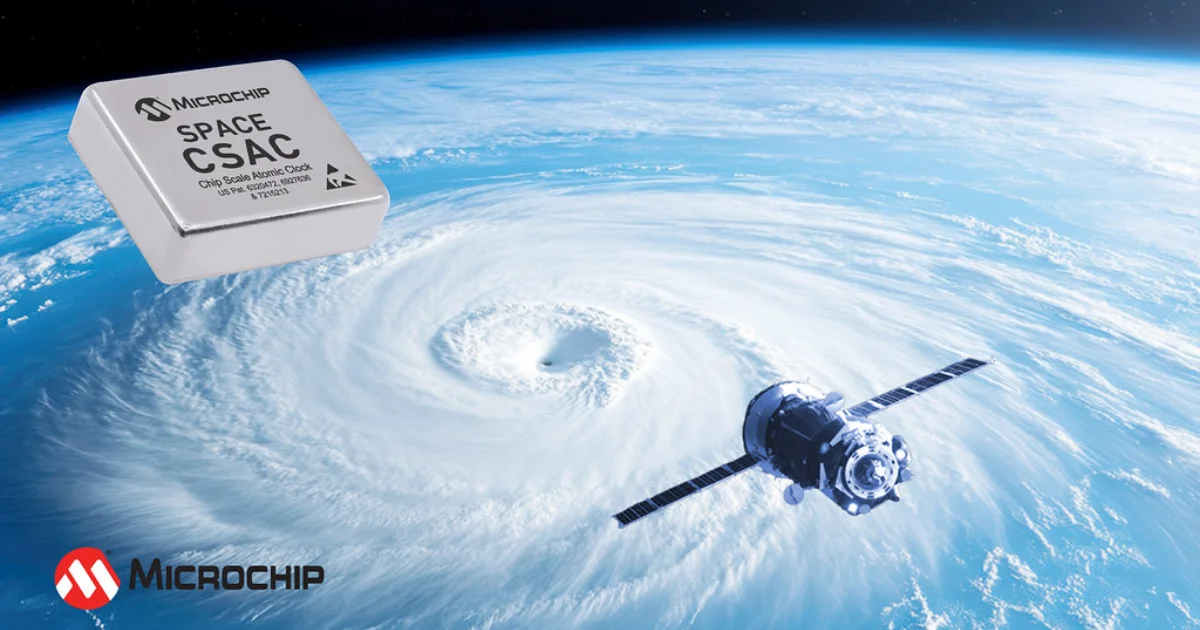
 Microchip has expanded its space timing portfolio with the Space CSAC-SA65, a chip-scale atomic clock developed for satellites and other systems where power consumption and available space are tightly limited. The new device is rated to at least 30 krad of radiation exposure, operates from -40°C to +80°C and consumes less than 120 mW.
The CSAC-SA65 also adds built-in 1 PPS input and output capabilities for synchronisation. Microchip is targeting Low Earth Orbit missions including satellite timing, assured positioning, navigation and timing, and satellite cross-links.
Atomic Timing in Less Than 17 cc
Atomic clocks provide a stable local timing reference without requiring continuous access to an external source. For a satellite, this can maintain timing and frequency accuracy during periods when a GNSS reference isn't available.
The Space CSAC-SA65 packages that capability into a volume of less than 17 cc. Power consumption is below 120 mW, making the device an option for CubeSats and other spacecraft where the size, weight and power allocated to timing hardware are limited.
Built-in 1 PPS input and output allows the clock to synchronise with other timing sources and distribute a timing reference elsewhere in the satellite. When an external reference becomes unavailable, the atomic clock can continue providing its local reference.
Radiation Tolerance to at Least 30 krad
The CSAC-SA65 builds on Microchip's earlier Space CSAC-SA45, extending radiation tolerance to at least 30 krad and widening the operating temperature range to -40°C to +80°C.
Microchip has taken a COTS approach rather than designing the SA65 as a traditional radiation-hardened timing product. The clock is manufactured using radiation-tolerant commercial electronic components, with the company positioning it for shorter-duration LEO missions where the cost, size and procurement requirements of conventional space-grade oscillators may not be necessary.
This distinction is important for designers evaluating the device: the CSAC-SA65 is specified as radiation tolerant rather than radiation hardened.
Built for LEO Satellite Timing
Microchip lists satellite timing and frequency control, satellite clock references, assured PNT and satellite cross-linking among the intended applications for the new clock. The ability to maintain a stable local reference can also reduce dependence on continuous GNSS reception. This is relevant to spacecraft that need to retain timing during interrupted or unavailable external references, rather than treating GNSS as the sole source of timing information.
For development and configuration, the CSAC-SA65 is supported by Microchip's ClockStudio software for atomic-clock control and analysis. A CSAC Developer Kit is also available for evaluation and integration work.
The Space CSAC-SA65 is available now under part number 090-02789-007 through Microchip and its authorised distributors.
Learn more and read the original announcement at the Microchip website.
Technology Overview
A chip-scale atomic clock uses an atomic resonance as its frequency reference, providing substantially greater long-term timing stability than conventional crystal-based oscillators while reducing the size and power requirements associated with traditional atomic clocks. In space systems, a local atomic reference can maintain accurate timing when an external reference such as GNSS is temporarily unavailable.
Frequently Asked Questions
What is the Microchip Space CSAC-SA65?
The Space CSAC-SA65 is a radiation-tolerant chip-scale atomic clock designed for space applications. It consumes less than 120 mW, occupies less than 17 cc and includes built-in 1 PPS input and output.
How radiation tolerant is the CSAC-SA65?
Microchip specifies radiation tolerance of at least 30 krad. The device is manufactured as a COTS product using radiation-tolerant commercial electronic components and should not be confused with a radiation-hardened atomic clock.
What applications is the CSAC-SA65 designed for?
Microchip is targeting LEO applications including satellite timing and frequency control, satellite clock references, assured positioning, navigation and timing, and satellite cross-linking.
You may also like