
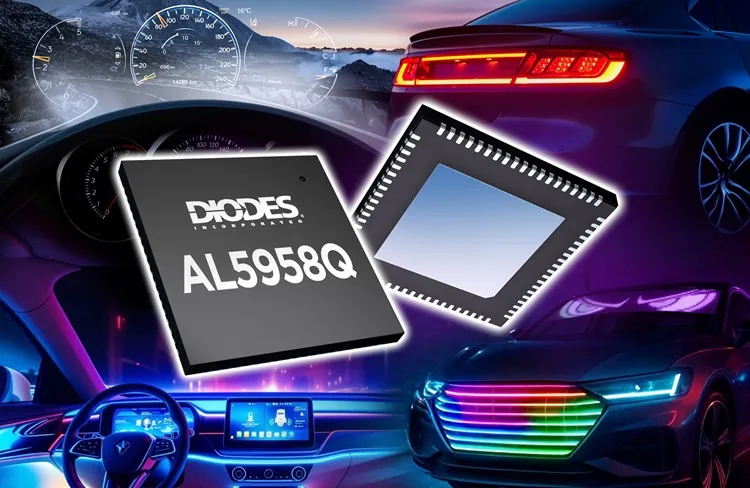
 As automotive lighting shifts towards dense LED arrays, from head-up displays to illuminated grilles and adaptive rear lamps, engineers face recurring problems. Driving dozens of RGB channels through scanning introduces motion blur. Parasitic capacitance between lines creates ghosting artefacts. And when higher refresh rates are used to improve image quality, EMI becomes a compliance headache. These issues can turn what looks like a simple LED matrix into a complex design challenge.
A Driver Built for Dynamic Lighting
Diodes Incorporated has introduced the AL5958Q, a 48-channel automotive-qualified LED driver aimed directly at these problems. The device supports up to 32 scans, making it suitable for narrow pixel mini and micro LED arrays that demand crisp, animated visuals. Integrated 16 N-MOSFET switches provide flexibility for static or dynamic operation, and unlimited daisy-chain capability means engineers can scale displays without major architectural changes.
Solving Artefacts at the Hardware Level
Instead of relying on the host microcontroller to manage artefact suppression, the AL5958Q embeds several corrective functions in hardware:
- Black-frame insertion reduces blur caused by rapid scanning.
- Scan-line compensation counters ghosting from parasitic capacitance.
- Short-LED detection and error flags provide diagnostics at the channel level.
- Staggered current output helps control inrush current at start-up.
By shifting these responsibilities into the driver IC, designers can simplify firmware and free up resources for higher-level application code.
Precision, Colour Control and EMI
The device offers 16-bit dimming resolution, allowing smooth gradients and precise RGB colour mixing, a level of control that supports OEM “signature lighting” where colour consistency is critical. Current can be set with external resistors or via internal registers, giving flexibility during system design.
A key differentiator is the use of multiplex-pulse density modulation (M-PDM). This approach raises the effective refresh rate of dynamic scanning systems without increasing grayscale clock frequency. The result is better visual quality while keeping EMI within tight automotive limits, a practical advantage during compliance testing.
Takeaway for Engineers
The AL5958Q is more than a high-channel driver. It tackles the three pain points that often slow LED matrix development: blur, ghosting, and EMI. For systems where animated lighting is central, such as head-up displays, adaptive rear lamps, or complex interior panels, the device reduces firmware complexity and improves reliability. Simpler static arrays may not require their full feature set, but for dynamic displays, it offers engineers a way to push lighting design further without adding hidden cost or development time.
The AL5958Q operates across -40°C to +125°C, comes in an AEC-Q qualified QFN9090-76 package, and is available now at $1.60 in 2,500-piece quantities. A standard AL5958 version is also offered for industrial and commercial use.
Learn more and read the original announcement here.
You may also like