
 Modern vehicles aren’t just mechanical systems anymore; they’re full-scale digital networks. Between the cameras, sensors, and processors, there’s an endless stream of data moving around the car. Keeping that data stable while managing power budgets is becoming one of the harder design jobs, particularly for electric vehicles where efficiency matters as much as speed.
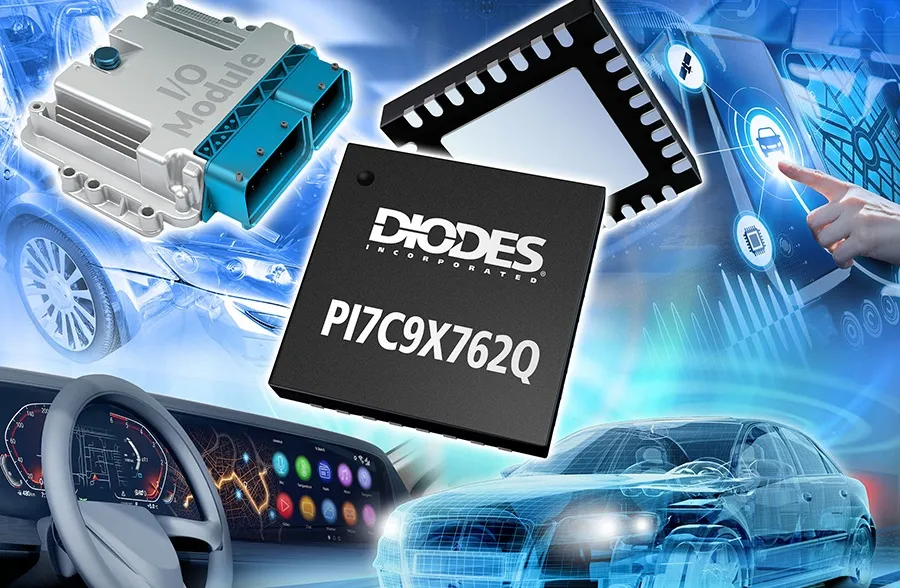
That’s where Diodes Incorporated’s new PI7C9X762Q comes in. It’s a bridge that connects I2C or SPI buses to a pair of UART channels, helping different parts of the vehicle talk to each other without adding extra complexity. It’s aimed at smart cockpits, ADAS units, telematics, and zonal controllers, systems that rely on dependable, low-power communication between processors and peripherals.
Building a Reliable Connection
The bridge supports two-way data flow between I2C or SPI and UART signals. It can run SPI clocks up to 33 Mbps, and it includes 64-byte transmit and receive buffers with programmable trigger levels to keep transfers smooth. Developers can fine-tune how data is framed, from bit length to parity and stop bits, so it can drop neatly into existing setups. Because its internal registers match older UART designs, engineers don’t have to rewrite entire codebases when migrating to newer platforms.
Small Footprint, Smart Design
Measuring just 5 × 5 mm in a 32-pin TQFN package, the PI7C9X762Q saves valuable board space and still manages to include eight programmable GPIO pins. It also adds a few useful touches such as automatic flow control, fractional baud rate support, and a software reset function that lets the UART recover independently from the main system.
The focus on power efficiency makes it well suited to EV platforms. It draws little current while running and even less in standby, which helps engineers meet aggressive efficiency targets. With AEC qualification and IATF 16949-certified production, it’s built to withstand the demands of long-term automotive use.
Why It Matters
Vehicle networks are becoming more modular and distributed, and the interfaces connecting them have to keep up. Devices like the PI7C9X762Q make it easier to bridge communication gaps between sensors, controllers, and compute modules. It’s a practical, low-power part that fits quietly into the background, doing the work that keeps the rest of the system running smoothly.
Learn more and read the original article on www.diodes.com
You may also like