
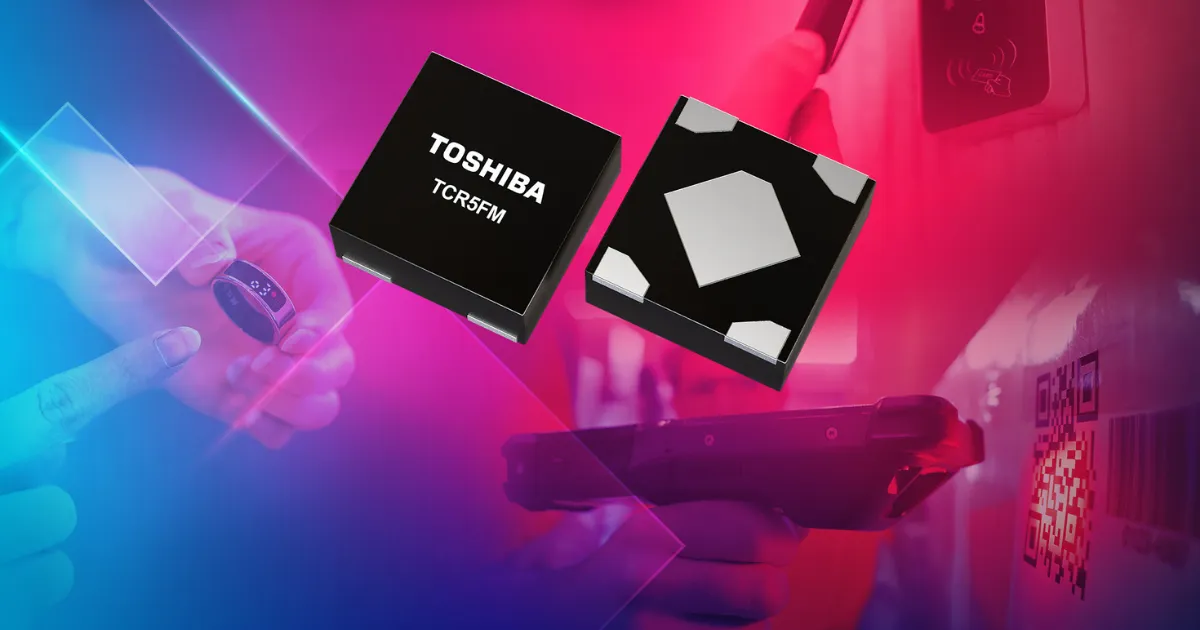
 Small battery powered devices move constantly between low power standby and bursts of high speed processing, and that behaviour can place real strain on the power rail. When the load jumps suddenly, the voltage can dip or overshoot before the regulator has time to react. Those disturbances show up as noise, instability or performance loss in sensors, radios and mixed signal blocks. Toshiba’s TCR5FM LDO series is built to handle these transitions more effectively, giving engineers a cleaner and more predictable supply rail in the smallest possible footprint.
Why Fast Load Recovery Matters In Modern Devices
Wearables, smartphones and sensor centric systems rely on aggressive power saving modes. When a processor wakes to handle a task, the load can change almost instantly. If the regulator cannot respond quickly, downstream circuits may see rail collapse, jitter or unwanted variation. Toshiba reports that the TCR5FM series improves load transient behaviour from standby by roughly eighty percent over the earlier TCR3RM devices. In practice this helps maintain voltage stability when activating radios, powering camera pipelines or waking sensor clusters that depend on clean and steady rails.
Technical Behaviour That Influences Noise And Stability
The regulators use a combination of a bandgap circuit, a low pass filter and a high speed low noise amplifier to maintain output accuracy during sudden load steps. A ripple rejection ratio of around ninety one decibels helps suppress upstream noise, which can be especially valuable when powering CMOS sensors or high frequency circuits that are sensitive to small disturbances. Output currents up to five hundred milliamps and voltage options from zero point nine to five volts allow the parts to support a broad set of digital and mixed signal domains. Operation is specified up to one hundred and twenty five degrees Celsius, giving some headroom for thermally constrained layouts.
Footprint And Practical Integration Considerations
The regulators come in a one millimetre by one millimetre DFN4D package, which is attractive for tightly packed boards where placement options are limited. Keeping the regulator close to the load helps reduce parasitic inductance and improves transient behaviour even further. For engineers tuning power rails in compact enclosures, the small footprint offers a way to maintain good power integrity without sacrificing valuable board area. The availability of thirty five output voltage variants also gives flexibility when matching rails to specific processors or sensor blocks.
Implications For Future Battery Powered Platforms
As portable systems push toward higher performance while keeping battery life steady, power management components need to keep pace. Faster wake up cycles, more sensors and higher frequency processing all create conditions where clean rails matter. Devices like the TCR5FM series illustrate how small improvements in transient speed and noise handling can support these trends. For engineers, the key point is that compact LDOs with strong dynamic behaviour can simplify rail design and improve overall system resilience as mobile platforms continue to evolve.
Learn more and read the original announcement at www.toshiba.semicon-storage.com
You may also like