
Diodes PI2MEQX2505Q Improves MIPI D-PHY Signal Integrity In High Resolution Automotive Cameras
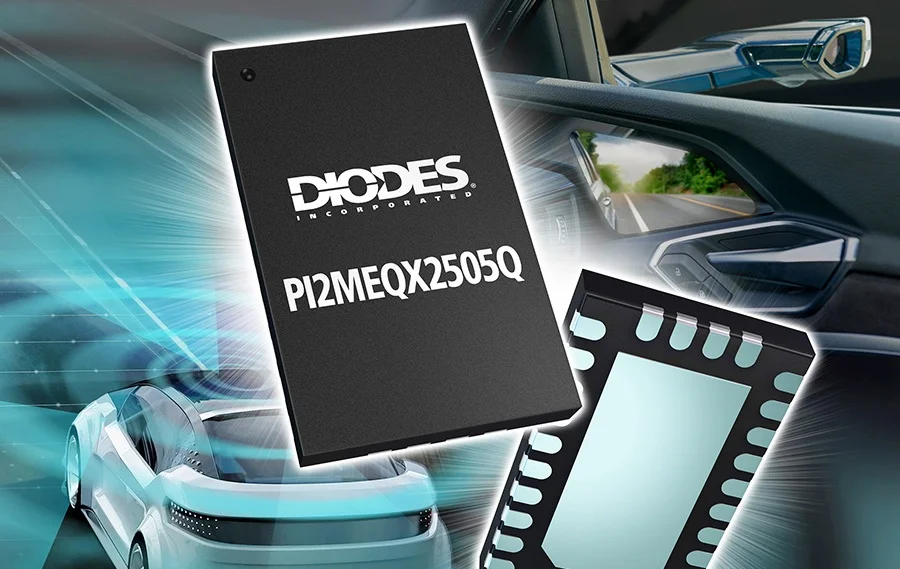 As automotive camera systems shift toward higher pixel counts and longer routing paths, the electrical margin on MIPI D-PHY links becomes more fragile. A single connector or tight bend in a cable can introduce just enough loss to destabilize communication between sensor modules and processing units. Designs that rely on longer traces inside dense ECUs often hit the same problem. Diodes’ new PI2MEQX2505Q ReDriver steps in to support these high bandwidth paths by restoring signal strength and timing before the channel begins to erode the link.
Restoring D-PHY Signaling Across Challenging Routing Paths
The device is built around the MIPI D-PHY 1.2 protocol and includes four data lanes and a clock lane. This aligns with the configurations found in modern camera monitoring systems where sensor data needs to travel across connectors, flex cables or long PCB routes into a central processor. The ReDriver compensates for frequency dependent loss by regenerating the signal and shaping it back into a form that tracks the original source. That behavior is important for high resolution imaging pipelines in which timing skew and attenuation can introduce visible artifacts or cause frame instability.
Configurable Equalization And Output Behavior For Real Systems
One detail worth noting is the degree of control available to engineers. Receiver equalization can be set to levels that counter the actual channel loss rather than forcing a fixed compensation curve. Transmit behavior can be adjusted through pre emphasis settings and output voltage swing adjustments, giving designers the ability to shape the signal based on board geometry and connector placement. These controls can be accessed through an I2C interface or through pin strap configuration when software control is not practical. The combination of programmable equalization, selectable pre emphasis and adjustable swing helps maintain the eye opening across a wider set of trace lengths without leaning on more complex routing strategies.
Power Behavior Suited For Battery Electric And Mixed Voltage Platforms
Camera systems inside battery electric vehicles bring additional constraints around quiescent power and standby modes. The PI2MEQX2505Q operates from a 1.8 volt supply and includes several lower power states that align with MIPI D-PHY link behavior. When the link drops into its low power mode or ultra low power state, the ReDriver follows that transition and reduces its consumption significantly. The active state draws up to 200 milliwatts, while the lower power states drop it into the milliwatt range. This behavior can help system architects meet vehicle level power budgets when cameras are not streaming.
Form Factor And Channel Density For Compact ECUs
The package measures 3.5 by 5.5 millimeters and supports high density routing, which is relevant for camera hubs and ADAS processors where the number of differential pairs adds up quickly. Variants with different lane counts are also available for commercial and industrial designs that do not require automotive compliance. For ADAS and camera monitoring systems that push resolution and lane utilization higher, the PI2MEQX2505Q provides a way to extend reach without switching to bulkier repeater modules or reworking the overall topology.
For engineers, the takeaway is that this ReDriver provides a practical blend of configurability, signal restoration and power behavior that suits the architecture of next generation camera and sensing systems. It preserves signal integrity in places where PCB geometry or cable length would normally limit performance.
Learn more and read the original announcement at www.diodes.com
You may also like