
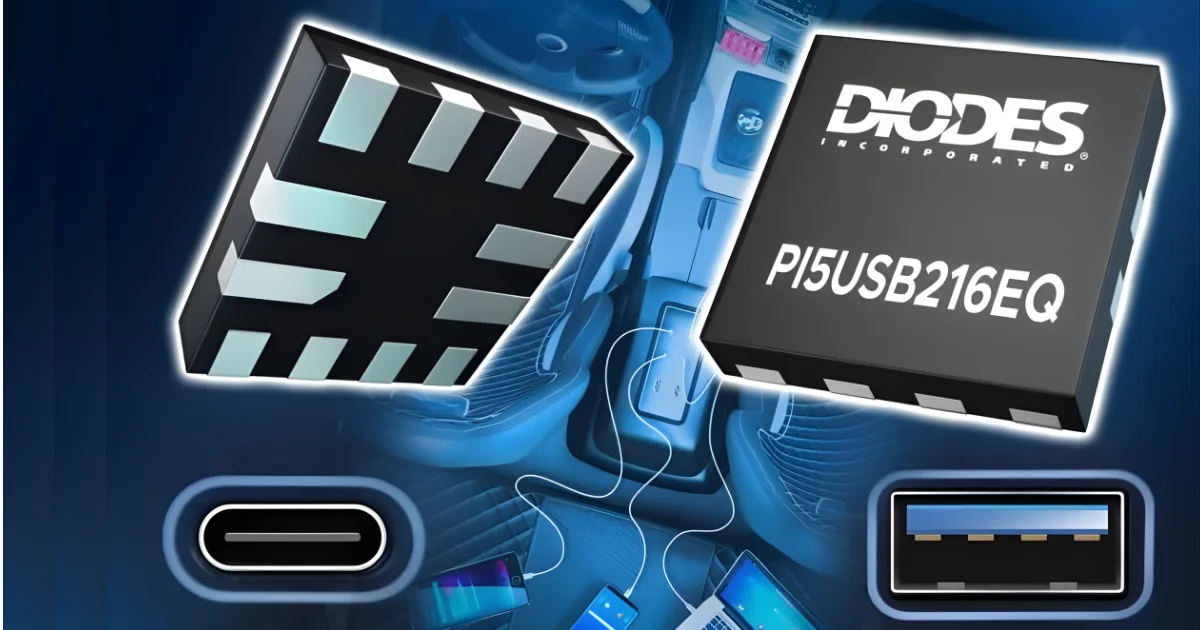
 As vehicles add more connected interfaces and rely on longer internal cable runs, USB 2.0 often becomes the weakest part of the system. The PHY may sit deep inside an infotainment module while the accessible port sits meters away, and that distance introduces signal loss that chips at timing margins until devices negotiate inconsistently. Diodes approaches this problem with the PI5USB216EQ, a compact signal conditioner built to recover the shape of USB 2.0 signals so automotive USB channels remain reliable across longer paths.
Addressing ISI Loss in Automotive USB Paths
A common challenge in vehicle architectures is simply the distance between the port and the host controller. When that distance stretches, inter symbol interference becomes a dominant factor because the edges soften long before they reach the PHY. The PI5USB216EQ counters that by restoring amplitude and adding controlled pre emphasis so the signal arriving at the receiver still carries enough eye height to support 480 Mbps traffic. In practice this helps engineers maintain link stability without redesigning the mechanical layout around the USB connector. It also supports BC 1.2 CDP behaviour, which keeps legacy device charging intact inside glove box or rear passenger ports.
How the PI5USB216EQ Manages Signal Conditioning
The electrical behaviour of the device is shaped by two selectable control methods. Through I2C, engineers can tune boost levels alongside equalisation and sensitivity, which becomes useful when the USB channel varies between vehicle trims or cable suppliers. A simpler pin strap method is available when the application needs fixed settings without software involvement. The internal detection circuits recognise whether a USB device is attached and whether a high speed handshake has completed, and the supply current drops sharply when nothing is connected. This automatic reduction limits thermal load and is particularly helpful in systems where USB ports spend long periods idle.
Integration and Packaging Considerations for Automotive Use
The device arrives in a small 1.6 mm by 1.6 mm X2 QFN package, which suits crowded automotive PCBs where space is under pressure from surrounding power, audio and RF stages. The operating range accommodates typical USB supply domains and remains functional up to one hundred five degrees Celsius, so placement inside dashboard modules or center console hubs becomes more flexible. In real systems this allows designers to route longer USB paths with fewer constraints on where the PHY must sit. It also reduces dependency on thicker traces or controlled impedance structures that consume valuable board area. The small footprint makes it easier to drop the conditioner close to the connector or place it near the PHY, depending on how the channel behaves.
Where USB Conditioning Is Heading in Next Generation Vehicles
As automotive interiors shift toward heavier data sharing between displays, controllers and passenger interfaces, USB 2.0 will remain widely used even as higher speed standards expand. Long cable runs and varied connector locations will continue to stress signal integrity, especially when mechanical design drives placement more than electrical performance. Devices like the PI5USB216EQ reflect a growing trend toward localised signal conditioning rather than full architecture redesign. For engineers, the key point is that recovering USB margin with a compact conditioner can extend the life of existing designs while keeping ports responsive across the full range of cable lengths used inside modern vehicles.
Learn more and read the original announcement at www.diodes.com
You may also like