
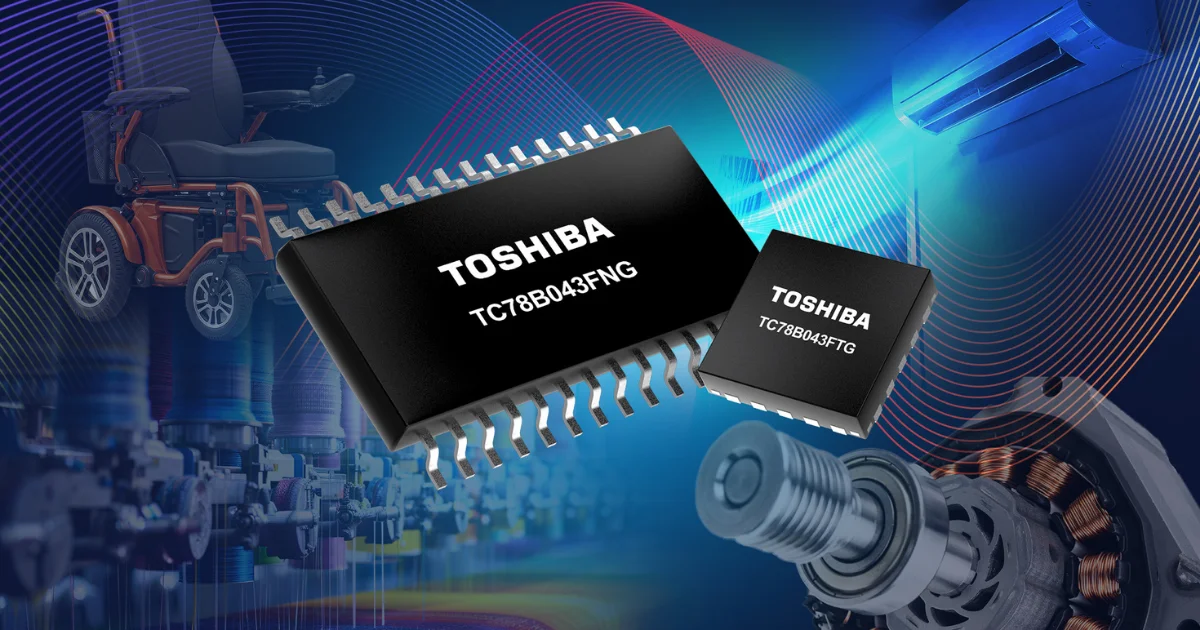
 Engineers working with small three phase BLDC motors often face a familiar tradeoff. Surface permanent magnet motors offer predictable behavior, but interior permanent magnet variants can deliver higher torque density and better output for the same footprint. The drawback is the acoustic signature that IPM machines tend to introduce, especially when driven with simple trapezoidal control. That gap has pushed designers toward sine wave architectures that smooth electrical transitions and give the controller more authority over torque ripple. Toshiba’s new TC78B043FNG and TC78B043FTG devices sit directly in this space by pairing high resolution sine wave generation with configuration options that suit a wide range of motors and operating environments.
High-Resolution Control That Reduces Mechanical and Electrical Noise
Both controllers use a sine wave PWM approach that shapes phase currents with far more granularity than a basic block commutation scheme. In practice, this helps keep vibration in check when an IPM rotor interacts with the stator field, since the torque profile becomes more continuous as electrical angle advances. The ability to run a sine wave start sequence also supports quieter spin up, which is often a weak point for compact motor systems. One detail worth noting is that the controllers store user defined speed and correction parameters in non volatile memory. This makes it easier to tune lead angle or refine behavior around a particular motor’s characteristics without reworking upstream firmware.
Configuration Paths for Rapid Development or Deeper Tuning
The two parts diverge in how they handle setup. The TC78B043FNG arrives from the factory with a preset collection of speed profiles that work for many common BLDC motors. For teams building cost sensitive or high volume systems, this can shorten time to first spin because no SPI configuration is required to reach a stable operating point. Engineers who do need finer control can still adjust lead angle or related settings through a group of dedicated pins, which allow analog tuning of parameters stored in NVM. The TC78B043FTG follows a more traditional model that expects full configuration over SPI, which suits platforms that already rely on digital control loops or supervisory MCUs.
Electrical Behavior Suited to Consumer and Industrial Designs
Supply voltage flexibility from 6 to 23 volts lets these controllers drop into a wide mix of consumer and industrial products. Air movers, small compressors, and compact actuators often run in this range, and all benefit from cleaner phase currents under variable load. Thermal shutdown, undervoltage lockout, over current detection, and lock protection give designers the safeguards expected in unattended systems. Each part also integrates a five volt regulator that can power Hall sensors or simple logic, which helps reduce the number of supporting components on the board and simplifies layout around the motor zone.
Packaging Options for Standard and Space-Constrained Layouts
Toshiba offers the TC78B043FNG in an HTSSOP28 package that suits general purpose drive boards where soldered leads simplify inspection and rework. The TC78B043FTG shifts to a three by three millimeter WQFN20 format for designs where space is constrained or where the controller must live close to the motor. That difference gives engineers a path to reuse the same control approach across multiple product tiers without changing firmware strategy or electrical behavior.
How These Controllers Fit Into Emerging BLDC Trends
As more appliances and distributed industrial systems migrate to efficient IPM motors, the demand for controllers that can counteract vibration while maintaining efficiency continues to rise. High resolution sine wave control is becoming a baseline expectation even in lower cost equipment, especially as noise regulations tighten and end users look for quieter operation. For engineers, the takeaway is that these controllers offer a practical way to push torque density and acoustic performance without adding complexity to the rest of the system design.
Learn more and read the original announcement at www.toshiba.semicon-storage.com
You may also like