
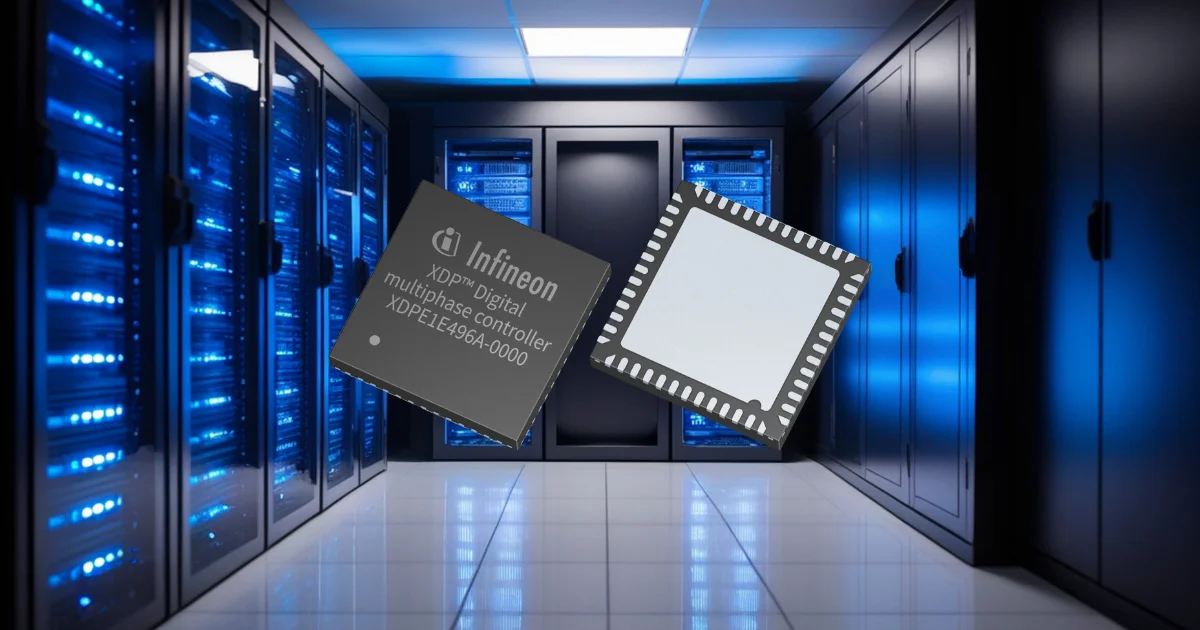
 AI server power has stopped being a single-rail problem. The headline current still sits around the core rails, but the board around them is getting busier, not quieter. More support rails, more telemetry, more pressure on layout, and less patience for long bring-up cycles. On a modern accelerator board, voltage regulation is starting to feel less like one power block and more like a distributed system that has to stay coordinated under load.
Infineon’s latest VR release leans directly into that split. The XDPE1E3G6A and XDPE1E496A are digital multiphase PWM buck controllers for AI server core rail regulation, while the TDA49720, TDA49712, and TDA49706 are PMBus-enabled integrated point-of-load buck regulators for non-core rails. In a typical AI platform, the multiphase controllers sit around the processor power stages handling the heaviest rails, while the smaller PoLs are spread across the board feeding memory, I/O, management, and other supporting circuitry.
The reason this launch feels timely is that AI boards no longer struggle only with peak current. They also struggle with rail count, board-space efficiency, and how quickly the whole power tree can be tuned, monitored, and reused across the next processor generation without starting over from scratch.
Core Rail Controllers Need To Stay Flexible
The XDPE1E3G6A and XDPE1E496A are aimed at the part of the design that still gets most of the attention: the core rails. Infineon describes them as digital 3-loop and 4-loop multiphase PWM buck controllers built for multi-processor AI platforms and advanced VR inductor topologies. That matters because these boards are changing fast, and a controller that locks the design too tightly to one platform quickly becomes a problem rather than a solution.
Infineon says the controllers support configurable phase allocation, programmable phase firing order, and multiple processor-facing protocols including PMBus, AVSBus, SVID, and SVI3. That gives the parts a better chance of surviving platform changes without forcing a full VR rethink. In this part of the board, flexibility is not just a nice digital feature. It is often what decides whether a design can be carried forward at all.
There is also the usual AI load problem. Fast transients do not wait for tidy compensation schemes. Features like Active Transient Response, fast DVID, automatic phase shedding, and PFM are all clearly there to keep the controller usable once the load starts moving the way accelerator silicon tends to move.
The Smaller Rails Are Becoming Harder To Ignore
The second family is quieter, but just as important. The TDA49720, TDA49712, and TDA49706 are integrated PMBus point-of-load buck regulators for the non-core rails that keep multiplying across server and accelerator boards. These rails used to feel secondary. They do not anymore, especially once their combined layout footprint and management overhead start eating into the rest of the design.
Infineon is offering 20 A, 12 A, and 6 A versions in 3 mm x 3 mm and 3 mm x 3.5 mm packages. That kind of package size matters because non-core rails have a habit of appearing in exactly the parts of the board where space is already gone. The family also includes PMBus telemetry for output voltage, load current, input voltage, and die temperature. At this point, visibility into those rails is becoming part of the design requirement, not an optional extra for people who enjoy dashboards.
This is especially true during bring-up. Once the board is packed with regulators, smaller rails can waste a lot of time simply by being harder to observe and tune. Telemetry helps, but it also changes expectations. The regulator is no longer just there to provide power. It is there to explain what it is doing while the rest of the system comes alive around it.
Fast Transient Response Is No Longer Just For The Big Rails
Infineon says the PoLs use a proprietary valley current mode constant on-time control scheme to support fast transient response, cycle-by-cycle current limiting, and all-MLCC output capacitance designs. They operate from 2.7 V to 16 V input and across a junction temperature range of -40 °C to 150 °C. Those are practical numbers for server boards, where even the supposedly secondary rails are expected to be compact, fast, and thermally resilient.
What this release really shows is that AI server VR is spreading outward. The hard part is not only feeding the biggest rail efficiently. It is building a regulation architecture that works from the core outward to the smaller rails without turning the board into a collection of disconnected power islands. Infineon is clearly trying to answer that with one family aimed at scalable multiphase control and another aimed at dense, monitored point-of-load regulation. It is a sensible direction. AI boards are not getting simpler, and neither is the power tree.
Learn more and read the original announcement at www.infineon.com
Technology Overview
The XDPE1E3G6A and XDPE1E496A are digital multiphase PWM buck controllers for AI server core rail voltage regulation. The TDA49720, TDA49712, and TDA49706 are integrated PMBus point-of-load buck regulators for non-core rails, offered in 20 A, 12 A, and 6 A versions. The PoL devices operate from 2.7 V to 16 V input and provide telemetry for output voltage, load current, input voltage, and die temperature.
Frequently Asked Questions
What are Infineon XDPE1E controllers used for?
They are used for digital multiphase buck control in AI server and multi-processor voltage regulation designs.
What current options are available in the TDA49720, TDA49712, and TDA49706 family?
Infineon offers 20 A, 12 A, and 6 A versions of the integrated PMBus point-of-load regulators.
You may also like