
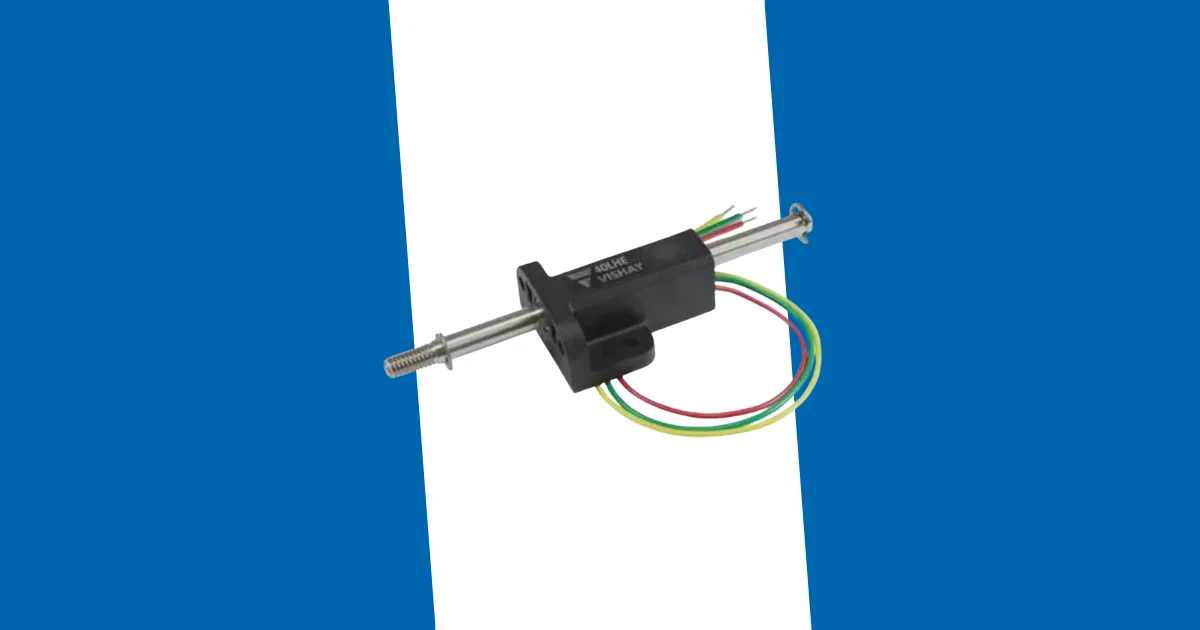
 Linear position sensors are not especially rare, but the useful ones tend to separate pretty quickly from the brochure-friendly ones once they leave the lab. Stroke length, mechanical wear, mounting constraints, vibration, sealing, startup behavior, and output flexibility all start piling into the same decision. Vishay’s new 40 LHE is aimed right at that kind of application, where the sensor is expected to measure small displacement accurately, survive rough conditions, and come back to life after power loss without needing to be babied.
The 40 LHE is a compact non-contact linear position sensor used for displacement measurement in motion control, industrial automation, structural monitoring, and vehicle control systems. Vishay is using Hall effect sensing here, with linearity down to ±1% full stroke, 12 µm resolution, and an electrical stroke extended out to 40 mm. In a robotic gripper, crack monitoring sensor, or pedal position system, that matters because the position sensor often ends up being judged less by its nominal output and more by how reliably it behaves after vibration, shock, dirt, and repeated cycling have had time to do their work.
The Extra Stroke Length Is The Real Change
The jump to 40 mm is what makes this launch worth looking at. Previous-generation devices in this category were sitting around 10 mm of electrical stroke, which is fine for some tight feedback loops but starts becoming restrictive once the motion being measured is less controlled or simply larger by nature.
That added range opens the sensor up to a wider set of displacement tasks without forcing designers into a different sensing approach entirely. Structural crack monitoring, dendrometers in digital farming, in-line process measurement, and robotic grippers all benefit from that. These are not all the same kind of system, but they do share one thing: the sensor has to follow physical movement that is not always neat, repeatable, or electrically convenient.
Non-Contact Sensing Helps Once The Environment Turns Ugly
Hall effect sensing is not new, but it stays useful for a reason. Once a sensor has to survive millions of cycles in a dirty or mechanically hostile setting, avoiding physical contact inside the measurement mechanism starts looking less like a feature and more like the baseline requirement.
Vishay says the 40 LHE is rated for more than 10 million cycles, which fits the kind of application where repeated movement is expected rather than occasional. The IP67 sealing also matters here, along with vibration tolerance up to 20 g and shock resistance up to 50 g. Those numbers are not there to make the spec sheet look tough. They tell you the sensor is meant for places where movement, contamination, and mechanical stress are normal operating conditions, not edge cases.
Startup Behavior Often Gets Ignored Until It Causes Trouble
One of the more useful details in the release is the true power-on behavior. The 40 LHE reports its position immediately at startup, without recalibration, re-homing, or initialization, even after power loss. That is the kind of thing that can save far more time in a real machine than a small improvement in raw measurement spec.
In motion systems, losing position knowledge after a power interruption is annoying at best and expensive at worst. If the sensor can come back and report its state immediately, the surrounding control system becomes easier to manage. Vishay also points out that this removes the need for battery backup purely to preserve positional information, which is a practical design benefit, not just a nice extra.
Integration Looks Thought Through
The rest of the part looks sensibly built for integration. Vishay offers analog ratiometric and PWM output options, which gives the 40 LHE a better chance of fitting into mixed automation and control platforms without extra interface compromises. The dual-face fixing holes for horizontal or vertical mounting are not glamorous, but they are exactly the kind of detail that makes installation less awkward in cramped mechanical assemblies.
Integrated reverse voltage and overvoltage protection also helps. Vishay specifies protection to -10 VDC and +20 VDC, which reduces the need for external protection circuitry in systems where wiring mistakes or supply disturbances are not theoretical. None of this turns the 40 LHE into a dramatic product launch, but that is not really the point. What Vishay has done here is make linear sensing more usable across a wider range of harsh, real-world motion systems without turning the part into something bulky or fiddly.
Learn more and read the original announcement at www.vishay.com
Technology Overview
The Vishay Sfernice 40 LHE is a non-contact Hall effect linear position sensor designed for displacement measurement over an electrical stroke of up to 40 mm. It provides linearity down to ±1% full stroke, 12 µm resolution, analog ratiometric or PWM output, and immediate position reporting at power-up. View the 40 LHE datasheet.
Frequently Asked Questions
What is the Vishay 40 LHE used for?
The 40 LHE is used for displacement measurement in systems such as robotic grippers, structural monitoring sensors, in-line process measurement, throttle and pedal sensing, and agricultural or transport equipment.
What stroke and resolution does the Vishay 40 LHE support?
Vishay states that the 40 LHE supports an electrical stroke up to 40 mm and resolution of 12 µm.
You may also like