
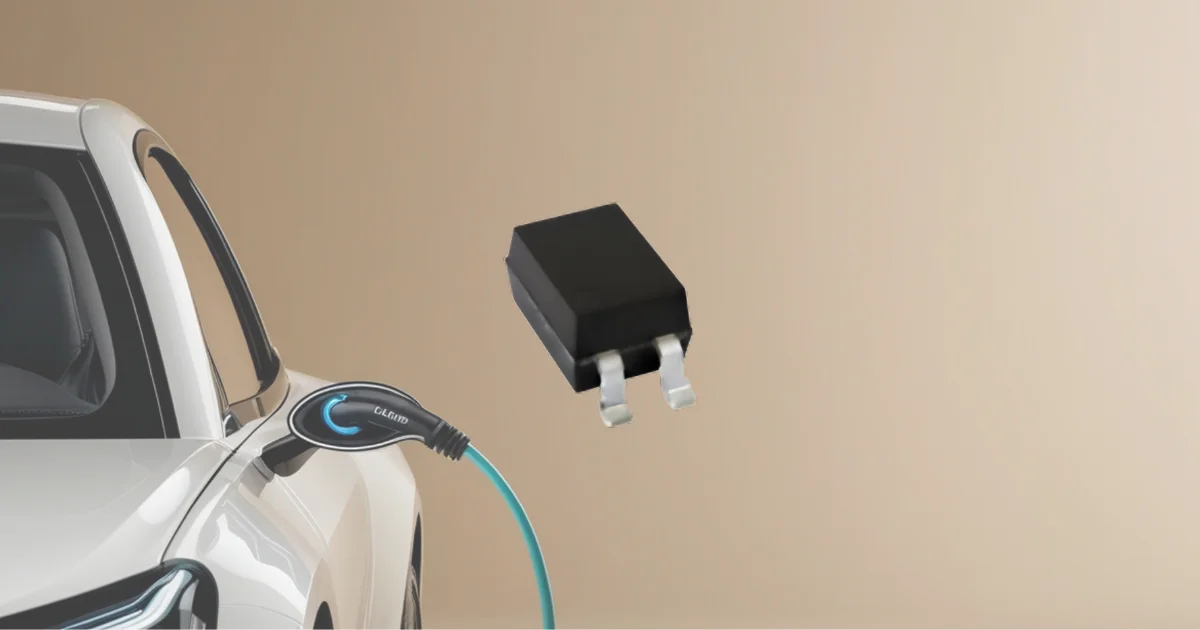
 High-voltage automotive switching keeps getting pushed into spaces where the old relay-first mindset stops making much sense. Pre-charge paths, battery disconnect functions, charger stages, and isolation-critical switching all want more reliability, less mechanical baggage, and fewer awkward support circuits hanging around the gate drive. Vishay’s VODA1275 lands right in that territory, and the interesting part is not that it is isolated, it's that it gets enough voltage out of a compact photovoltaic driver to stop designers stacking parts just to make the gate behave.
The VODA1275 is an automotive-grade photovoltaic MOSFET driver used to drive MOSFETs and IGBTs across an isolation barrier in high-voltage systems. In a typical EV pre-charge circuit or battery management path, that gate driver sits between low-voltage control logic and a much less forgiving switching node, where isolation distance, gate voltage, and long-term reliability all start fighting for board space at the same time.
One Driver Instead Of Two Changes The Tradeoff
That is really the center of this release. Vishay says designers have often needed two MOSFET drivers in series to generate the higher voltages required in these kinds of applications. The VODA1275 pushes that back with a typical open-circuit voltage of 20 V and short-circuit current of 20 μA, which is enough to make a single-device approach viable in circuits that previously needed more support around them.
That is not just a component-count story. Once two isolated drivers become one, the design pressure shifts. Board area eases up a little, routing gets less awkward, and the isolation problem stops spreading across more of the layout than it needs to. In high-voltage automotive hardware, that sort of simplification matters because the relay replacement story is only convincing when the solid-state version does not bring a pile of new complexity with it.
Isolation Distance Starts Doing Real Work
Vishay is putting a lot of weight on the package here, and fairly so. The VODA1275 is the first automotive-grade photovoltaic MOSFET driver in a compact SMD-4 package to combine 8 mm creepage with a CTI 600 mold compound, while being classified for reinforced isolation. That combination is not decorative. Once systems move into 800 V and above, surface leakage distance and tracking resistance stop being spec-sheet filler and start turning into real constraints on what you can place where.
The device also carries a working isolation voltage of 1260 Vpeak and an isolation test voltage of 5300 VRMS. That puts it in the range of battery systems where the isolation barrier has to stay credible over time, not just survive a lab demo.
Faster Turn-On Helps More Than The Headline Suggests
Vishay also claims an 80 μs turn-on time, which it describes as three times faster than competing devices. Fast turn-on by itself is not automatically impressive, but in a photovoltaic driver it is useful because these parts are often judged against slower, compromise-heavy alternatives. If the gate gets driven more quickly and more reliably, then the case for replacing electromechanical relays with custom solid-state arrangements starts looking more practical.
The other useful detail is that the VODA1275 draws the current for its internal circuitry from an infrared emitter on the low-voltage side of the isolation barrier. That removes the need for an external power supply on the output side. Again, that sounds like a small implementation detail until you are the one trying to keep an HV switching stage compact, isolated, and worth manufacturing.
Built For The Parts Of EV Power That Stay Awkward
Vishay is targeting pre-charge circuits, wall chargers, and battery management systems in EV and HEV platforms, which makes sense because those are exactly the places where designers keep running into the same mix of high voltage, isolation spacing, and cost pressure. The VODA1275 does not make those problems disappear. It just removes one of the more annoying reasons those circuits get larger and more layered than they should be.
Learn more and read the original announcement at www.vishay.com
Technology Overview
The VODA1275 is an automotive-grade photovoltaic MOSFET driver for isolated driving of MOSFETs and IGBTs in high-voltage systems. It provides a typical open-circuit voltage of 20 V, typical short-circuit current of 20 μA, 1260 Vpeak working isolation voltage, and 5300 VRMS isolation test voltage in a compact SMD-4 package with 8 mm creepage. It is intended for applications such as pre-charge circuits, wall chargers, and battery management systems in EV and HEV platforms.
View the VODA1275 datasheet.
Frequently Asked Questions
What is the VODA1275 used for?
The VODA1275 is used to drive MOSFETs and IGBTs across an isolation barrier in high-voltage automotive systems such as pre-charge circuits, wall chargers, and battery management systems.
What makes the VODA1275 different from other photovoltaic MOSFET drivers?
Vishay says it is the first automotive-grade device in a compact SMD-4 package to provide 8 mm creepage and CTI 600 mold compound, while also delivering 20 V typical open-circuit voltage.
You may also like