
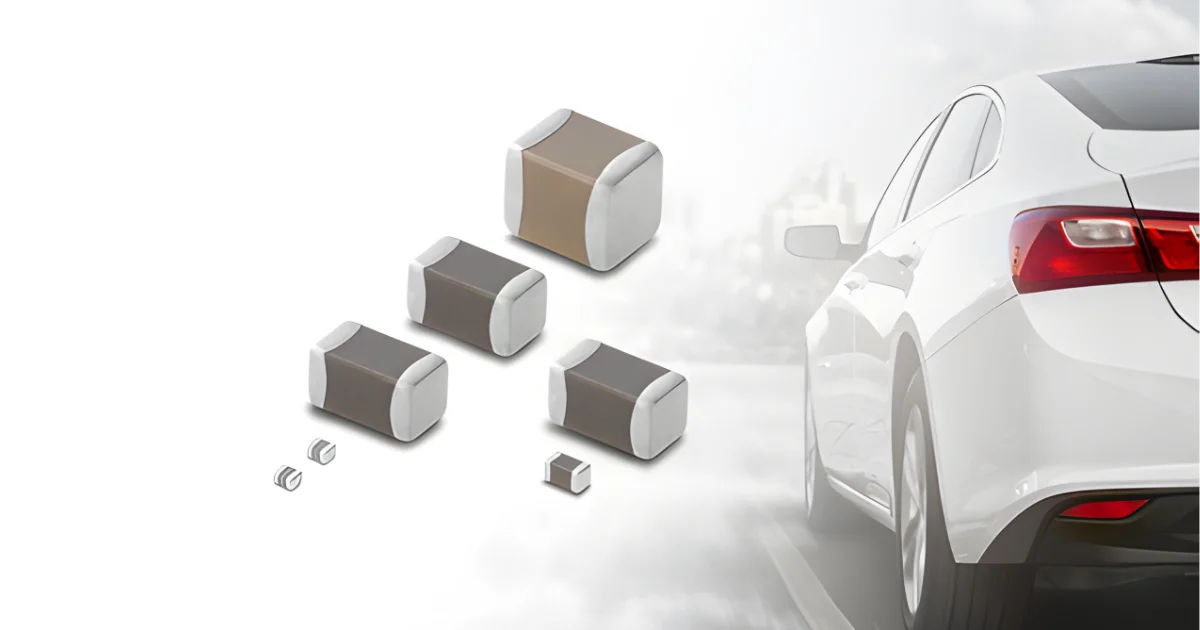
 Murata has started mass production of seven automotive MLCCs that move some awkward capacitance values into smaller packages than automotive designers have had before. The new parts are AEC-Q200-qualified GCM-series multilayer ceramic capacitors covering 2.5 Vdc, 4 Vdc, and 25 Vdc applications, aimed at IC peripheral circuits in ADAS and autonomous driving hardware as well as in-vehicle power lines. The interesting part is not the usual “more in less” headline on its own, it's what happens to the board once capacitance that previously forced a larger footprint can be pulled into a tighter area without giving up rated voltage.
Modern automotive electronics are not short on functions anymore. They are short on breathing room. Around processors, memory, sensors, and interface devices, the capacitor network keeps expanding because local stability still depends on it, while the rest of the PCB is already being squeezed by denser routing and more system content. However, the same pressure shows up on the power side too, where higher capacitance in smaller packages starts shaping how supply rails can be laid out around the load.
Smaller Packages Start Changing The Layout
Murata is claiming the world’s largest capacitance for rated voltage and size across all seven parts, but the more useful way to read the release is through board-level consequence. One of the clearest examples is 100 µF in a 1206-inch package at low voltage, where that value had previously been available only in the larger 1210-inch size. Murata says that cuts PCB mounting area by around 36%.
On a crowded ADAS board, this frees up space very quickly. The issue is rarely one capacitor by itself. It is the cluster effect. Support parts build up around high-value ICs until placement starts feeling forced, and every saved millimeter begins to open routing options that were not there before. Once a capacitor shifts down in size without giving up the electrical target, the gain is not just density. It changes how the surrounding circuitry can be arranged.
Low-Voltage IC Support Is Still A Growing Problem
The low-voltage section of the lineup is clearly aimed at that support-network pressure. Murata has expanded its range of automotive MLCCs with capacitance of 100 µF or higher, including the 2.5 Vdc GCM31CD70E107ME36 and the 4 Vdc GCM31CD70G107ME36, both delivering 100 µF in 1206-inch packages. The GCM32ED70G227MEC4 goes further with 220 µF at 4 Vdc in a 1210-inch package.
Now add the smaller end of the range. The 2.5 Vdc GCM035D70E225ME02 and 4 Vdc GCM035D70G225MEC2 each provide 2.2 µF in the 0201-inch size, which is about as space-sensitive as automotive MLCC packaging gets. In a typical ADAS module, those parts sit around IC rails where local capacitance has to be present whether the layout likes it or not. Once those values move into tiny footprints, the capacitor network stops dictating as much of the placement.
Power-Line Density Is Being Pulled Down In Size Too
The two 25 Vdc devices are just as important, even if they do not carry the same headline impact. The GCM155D71E105KE36 provides 1 µF in a 0402-inch package, a value Murata says had previously required the larger 0603-inch size. That reduces mounting area by about 61%. The GCM31CC71E226ME36 delivers 22 µF at 25 Vdc in a 1206-inch package.
That shift is useful because automotive power sections are not immune to the same crowding. Once multiple supply rails, converters, and support networks are stacked into a compact module, medium-voltage MLCCs start eating area faster than expected. Pulling those values into smaller case sizes gives the designer more room to keep the rail stable without letting the passive network dominate the floorplan.
Automotive Capacitance Is Becoming A Board Constraint
Murata also points to lower MLCC count, reduced PCB material use, and lower manufacturing power consumption as downstream benefits. Those are fair enough, but the immediate engineering value is simpler. These parts give automotive designers more freedom to place the capacitance they already need in spaces that were becoming difficult to justify. Once board density reaches this level, the passive footprint is no longer a background detail. It starts deciding what the layout can afford.
Learn more and read the original announcement at www.murata.com
Technology Overview
Murata’s new GCM-series automotive MLCCs are AEC-Q200-qualified multilayer ceramic capacitors for low-voltage IC peripheral circuits and 25 Vdc in-vehicle power lines. The seven new parts cover 2.5 Vdc, 4 Vdc, and 25 Vdc applications, with capacitance values ranging from 1 µF to 220 µF depending on package size and voltage class. The lineup includes new high-capacitance options in 0201-inch, 0402-inch, 1206-inch, and 1210-inch sizes.
Frequently Asked Questions
What are Murata’s new automotive MLCCs used for?
They are used around IC peripheral circuits in ADAS and autonomous driving systems, as well as in 25 Vdc in-vehicle power line applications.
Which Murata automotive MLCCs provide 100 µF in a 1206 package?
The GCM31CD70E107ME36 is rated at 2.5 Vdc and provides 100 µF in a 1206-inch package, while the GCM31CD70G107ME36 provides 100 µF at 4 Vdc in the same size.
Which new Murata MLCC provides 1 µF in a 0402 package at 25 Vdc?
The GCM155D71E105KE36 is rated at 25 Vdc and provides 1 µF in a 0402-inch package.
You may also like