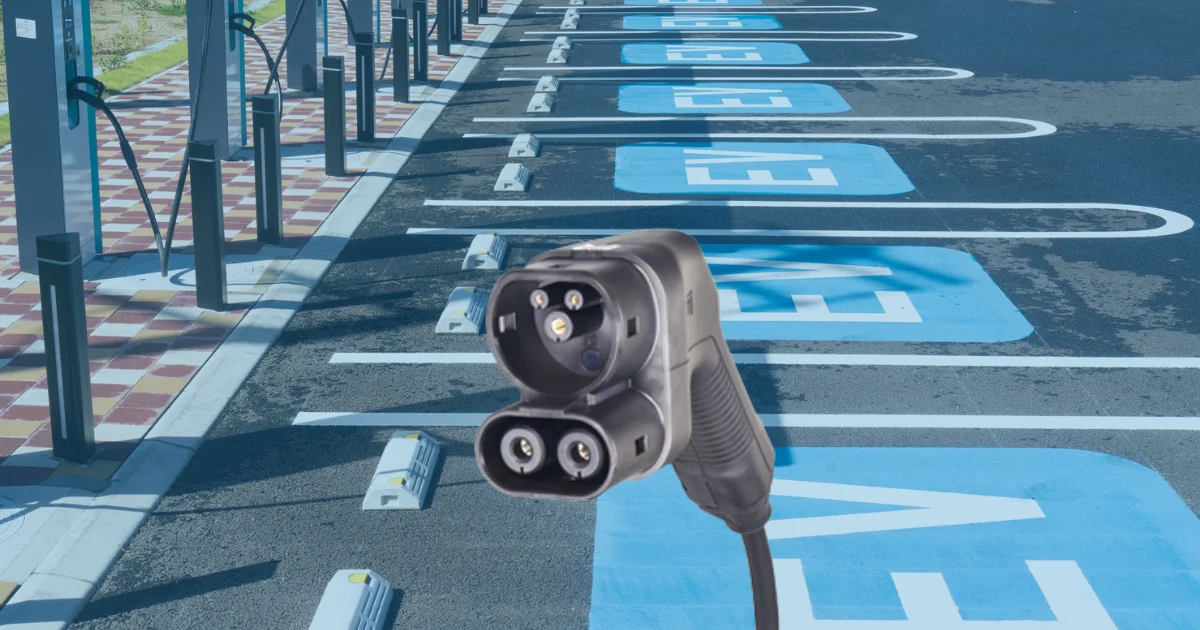
 JAE has released the KW21A Series, a CCS2 connector family for EV charging and discharging that now extends to 100 A operation for vehicle-to-grid and other bidirectional charging systems. The series is aimed at lower-power DC charging infrastructure where continuous connection, manageable cable handling, and support for bidirectional energy flow all matter just as much as basic compliance with the charging standard. In a typical installation, the connector sits at the charger-to-vehicle interface, where mechanical durability, weather resistance, and safe handling are just as important as current rating.
The KW21A Series is a CCS2 EV charging and discharging connector family used for DC charging systems and V2G-capable infrastructure. JAE positions the range around 40 A and 100 A solutions at up to 1,000 V DC, which means the higher-current version can support up to 100 kW in a 1,000 V battery system or around 40 kW in a more typical 400 V vehicle architecture.
A CCS2 Connector Built Around Lower-Power Bidirectional Use
The interesting part of this launch isn't just the move to 100 A. It is the way JAE is framing the connector around bidirectional charging rather than only conventional one-way DC fast charging. The company’s description leans toward lower-power continuous DC connection, where an EV can act as distributed storage for a home or the wider grid, feeding energy back when demand or pricing makes that worthwhile. That shifts the connector’s role slightly. It's not only about handling a charging session, but about supporting a charging and discharging link that may be used more flexibly over time.
That use case also helps explain why the KW21A remains focused on a compact, lightweight, and ergonomic cable assembly. High-power charging hardware often gets discussed in terms of raw output, but connectors intended for lower-power bidirectional systems need to be easier to handle in day-to-day operation. JAE says the grip structure is designed for comfort, while the cable is kept flexible enough to suit regular user interaction.
Mechanical Protection Matters as Much as the Rating
JAE is also emphasizing the physical design details around safety and durability. The connector uses a weather-resistant plastic body and a double-insulation structure intended to provide additional protection if the outer housing is damaged. For an outdoor charging interface that may see repeated handling, changing weather, and incidental abuse, those construction details are not secondary. They are part of what determines whether the connector remains dependable over time.
The rest of the published specifications fit that same picture. JAE lists up to 10,000 mating cycles, dielectric withstanding voltage of AC 3,000 V, insertion force up to 100 N, and an operating temperature range from -35 C to +50 C. The inlet-mated protection rating is IP54, with IP44 when port-cover mated, while the connector body alone reaches IP67. Those figures place the product squarely in the environment expected for EV charging hardware rather than in a lighter-duty connector role.
Positioned for CCS2 Charging and Broader V2X Systems
The KW21A Series is compliant with IEC 62196-3 and built around the CCS2 charging standard, which remains the dominant DC charging interface in much of Europe. JAE also frames the product for broader V2X use, not just V2G, which opens the door to vehicle-to-home and vehicle-to-load systems using the same connector platform. That wider positioning makes sense because the connector itself is not defining the power management strategy. It is providing the physical and electrical interface for systems that increasingly need two-way energy movement rather than simple one-way charging.
For designers of lower-power bidirectional DC chargers, that is probably the main point of interest here. The KW21A is not trying to be the biggest CCS2 connector in the market. It is aimed at a part of the charging ecosystem where manageable power, repeated use, bidirectional compatibility, and physical robustness all need to stay in balance.
Learn more and read the original announcement at www.jae.com
Technology Overview
The JAE KW21A Series is a CCS2 EV charging and discharging connector family for 40 A and 100 A DC charging systems at up to 1,000 V DC. It supports bidirectional charging applications, uses a double-insulated weather-resistant construction, and is specified for up to 10,000 cycles in EV charging and V2X infrastructure.
Frequently Asked Questions
What is the JAE KW21A Series used for?
It is used in CCS2-compatible EV DC charging and bidirectional charging systems, including V2G and broader V2X applications.
What current and voltage does the KW21A Series support?
JAE lists 40 A and 100 A power options, with a rated power-contact voltage of up to 1,000 V DC.
How durable is the KW21A connector?
JAE specifies the series for up to 10,000 mating cycles, with IP54 protection when inlet mated and operating temperatures from -35 C to +50 C.
You may also like