
 Current sensing used to be one of those quieter parts of a power design. Not easy exactly, but at least predictable. That has changed now that SiC and GaN stages are switching faster, edges are getting sharper, and the current waveform no longer behaves in a way older sensing approaches were really built around. In those systems, the sensor is not just reporting what happened. It is sitting right in the middle of whether the control loop can keep up without being dragged around by noise.
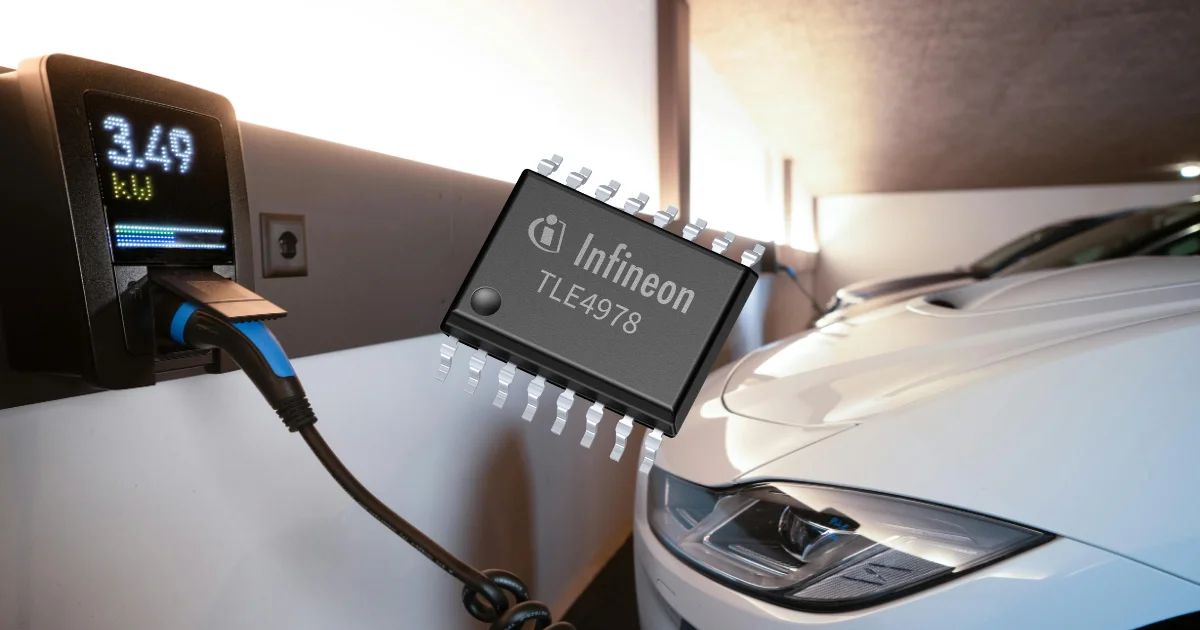
That is where Infineon’s XENSIV TLE4978 family comes in. The TLE4978 is a coreless isolated magnetic current sensor used for high-speed current measurement and protection in power conversion systems. In a typical EV onboard charger, DC-DC converter, PV inverter, or AI server power stage, a sensor like this is monitoring current fast enough for control, protection, and system efficiency to all depend on it.
What makes the TLE4978 different is the sensing structure itself. Infineon combines Hall sensing elements with monolithic differential air coils on the same die, so the device can handle lower-frequency and DC current information through the Hall path while the coil responds to rapid current changes at higher frequencies. That hybrid approach makes sense in modern power electronics, because one sensing method on its own often starts looking like a compromise once switching speeds rise.
Hall And Coil On One Die Changes The Tradeoff
The technical story here is really about balance. Hall sensors are useful for DC and low-frequency measurement, but they are not known for very high bandwidth. Coil-based sensing reacts faster, but it does not naturally give the same low-frequency and DC coverage. The TLE4978 is trying to sit between those two worlds rather than forcing the designer to choose one.
Infineon says the device delivers 9 MHz bandwidth with 38 mA rms noise, along with ±1.2 percent sensitivity error and ±200 mA offset error over temperature and lifetime from -40°C to 150°C. Those figures matter because fast-switching SiC and GaN platforms do not just need bandwidth in isolation. They need bandwidth that is still useful when noise, offset drift, and switching transients are trying to blur the measurement.
That becomes especially relevant in fast power stages where the current sense path is being asked to support both efficiency and protection at the same time. Once the measurement gets noisy or late, the converter may still run, but not as cleanly as the schematic promised.
Protection Speed Matters Once The Power Stage Speeds Up
The TLE4978 is also doing more than measurement. Infineon includes overcurrent detection with a 100 ns response time, which is the sort of figure that starts to matter once the switching hardware itself is capable of moving a lot of energy very quickly. In those conditions, slow protection is often not really protection.
The part also includes configurable OCD thresholds through a digital configuration and diagnostic interface or an external resistive divider, and Infineon says it is the first coreless magnetic current sensor with integrated zero crossing detection. That is a useful addition because zero crossing information can simplify control loop timing in systems where switching behavior needs to be tracked more precisely.
The device sits in a DSO-16 300 mil package with reinforced and basic isolation, 8 mm clearance and creepage, and a low current rail resistance of 550 µΩ. Infineon rates it for nominal currents up to 60 A. Those packaging and isolation details are not decorative. They are the reason a part like this can actually move from a clever sensing idea into real automotive and industrial hardware.
Fast Power Systems Need Better Current Visibility
The broader trend behind this part is easy to see. Faster switches have not only changed the transistor stage. They have raised expectations for everything around it, including the current sensor. That is why a hybrid architecture like this feels timely. It is aimed at the point where bandwidth, low noise, protection speed, and isolation all have to coexist in the same device.
Infineon positions the TLE4978 across EV charging, high-voltage DC-DC conversion, PV inverters, and AI data center power supplies, which fits the technology fairly well. These are all systems where high switching speeds promise better efficiency and density, but only if the current measurement stays trustworthy when the electrical environment gets noisy. That is usually where the more difficult part of the design begins.
Learn more and read the original announcement at www.infineon.com
Technology Overview
The XENSIV TLE4978 is a coreless isolated magnetic current sensor for power conversion systems. It combines Hall sensing elements and monolithic differential air coils on one die to measure current across low and high frequencies, with 9 MHz bandwidth, 38 mA rms noise, and support for nominal currents up to 60 A. The sensor includes overcurrent detection with 100 ns response time and is housed in a DSO-16 300 mil package.
View the part number/name datasheet
Frequently Asked Questions
What is the Infineon TLE4978 used for?
It is used for current measurement and protection in applications such as EV chargers, DC-DC converters, PV inverters, and AI data center power supplies.
What bandwidth does the TLE4978 support?
Infineon specifies a bandwidth of 9 MHz.
You may also like