 Nisshinbo Micro Devices has introduced the NT1741, an ultra-low-current Rx booster for 2.4 GHz wireless communications including Bluetooth Low Energy (BLE), Thread and Zigbee.
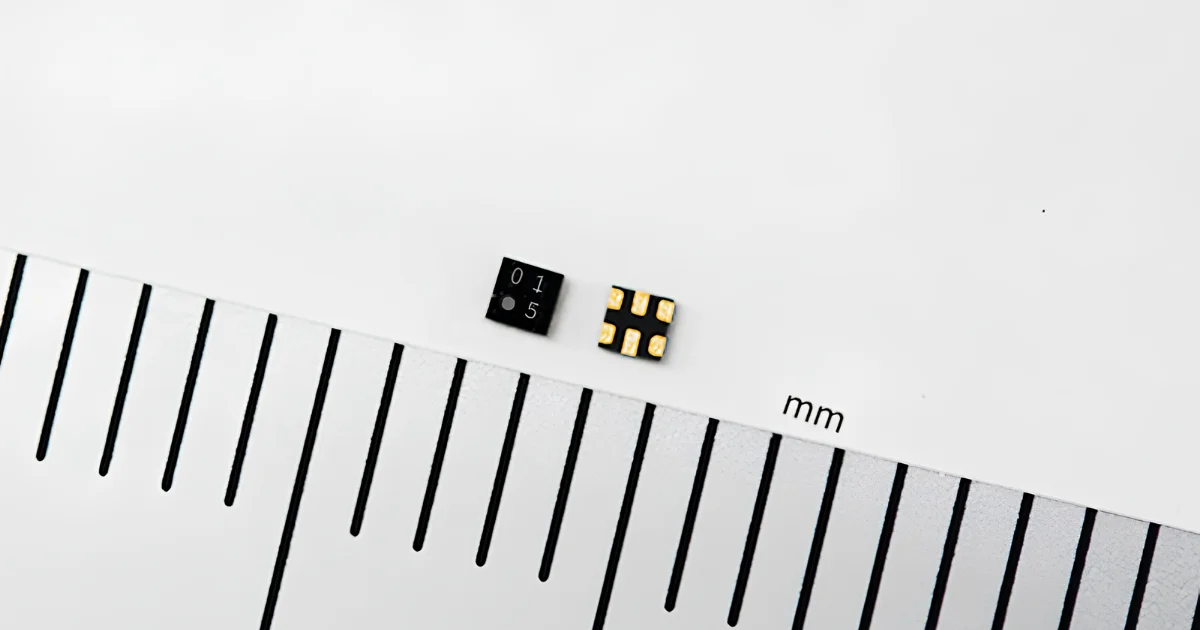
Designed for compact battery-powered devices, the NT1741 consumes 1.5 mA in LNA mode and 1 µA in bypass mode. The device comes in a 1.0 × 1.0 mm EPFFP-6-FB package, with the RF matching circuits integrated on-chip apart from the power-supply bypass capacitor.
Nisshinbo is initially targeting hearing aids, where receiver sensitivity, battery life and available PCB space are important design considerations. Other applications include AI glasses, earphones and headphones.
1.5 mA Current Consumption in LNA Mode
The NT1741 operates across the 2400 MHz to 2500 MHz frequency range and has a typical supply voltage of 1.8 V, with an operating range from 1.6 V to 3.7 V.
In LNA mode, the device provides 13 dB typical gain with a typical noise figure of 2.3 dB while drawing 1.5 mA. Input 1 dB compression point is specified at -13 dBm, with an input third-order intercept point of 0 dBm.
For applications that don't require the additional gain continuously, the NT1741 can be switched into bypass mode. Current consumption falls to 1 µA in this mode, with insertion loss specified at 1.0 dB.
The two operating modes allow the receive booster to be used when additional receiver performance is needed without maintaining the higher LNA current throughout operation.
1 × 1 mm Package with Integrated RF Matching
Nisshinbo has integrated the NT1741's input and output RF matching circuits into the device. No external matching circuit is required apart from a bypass capacitor at the VDD terminal.
This reduces the number of external components surrounding the Rx booster and the PCB area required for the RF circuit. The NT1741 itself measures 1.0 × 1.0 mm. The combination of the small package, integrated matching and low current consumption is aimed at compact wireless products where both board space and battery capacity are limited.
Hearing Aids and 2.4 GHz Wireless Devices
Hearing aids are one of the main applications identified for the NT1741. Wireless connectivity is increasingly used for functions including smartphone-based sound adjustment and Bluetooth LE Audio, while Auracast broadcast audio allows compatible devices to receive audio broadcasts in locations such as airports and public transport.
An Rx booster can be added between the antenna and wireless SoC to improve receiver performance where greater sensitivity or more reliable reception is required.
Beyond hearing aids, Nisshinbo lists AI glasses, earphones and headphones among the target applications. The 2400 MHz to 2500 MHz operating range also supports other 2.4 GHz wireless applications using BLE, Thread and Zigbee.
Sample orders for the NT1741 are scheduled to begin in December 2026, with Nisshinbo stating a monthly production capability of one million units.
Learn more and read the original announcement at nisshinbo-microdevices.co.jp.
Technology Overview
The Nisshinbo Micro Devices NT1741 is an ultra-low-current Rx booster for 2.4 GHz wireless applications. It provides 13 dB typical gain with a 2.3 dB noise figure, consuming 1.5 mA in LNA mode and 1 µA in bypass mode. The device measures 1.0 × 1.0 mm and integrates its RF matching circuits.
FAQs
What is the Nisshinbo NT1741?
The NT1741 is a 2.4 GHz Rx booster designed to improve receiver performance in compact wireless devices including hearing aids, AI glasses and earphones.
How much current does the NT1741 consume?
The NT1741 typically consumes 1.5 mA in LNA mode and 1 µA in bypass mode. It provides 13 dB typical gain in LNA mode.
Does the NT1741 require external RF matching components?
The input and output RF matching circuits are integrated on-chip. The only external matching-related component required is the bypass capacitor at the VDD terminal.
You may also like